NEWSROOM

News, NEWSROOM

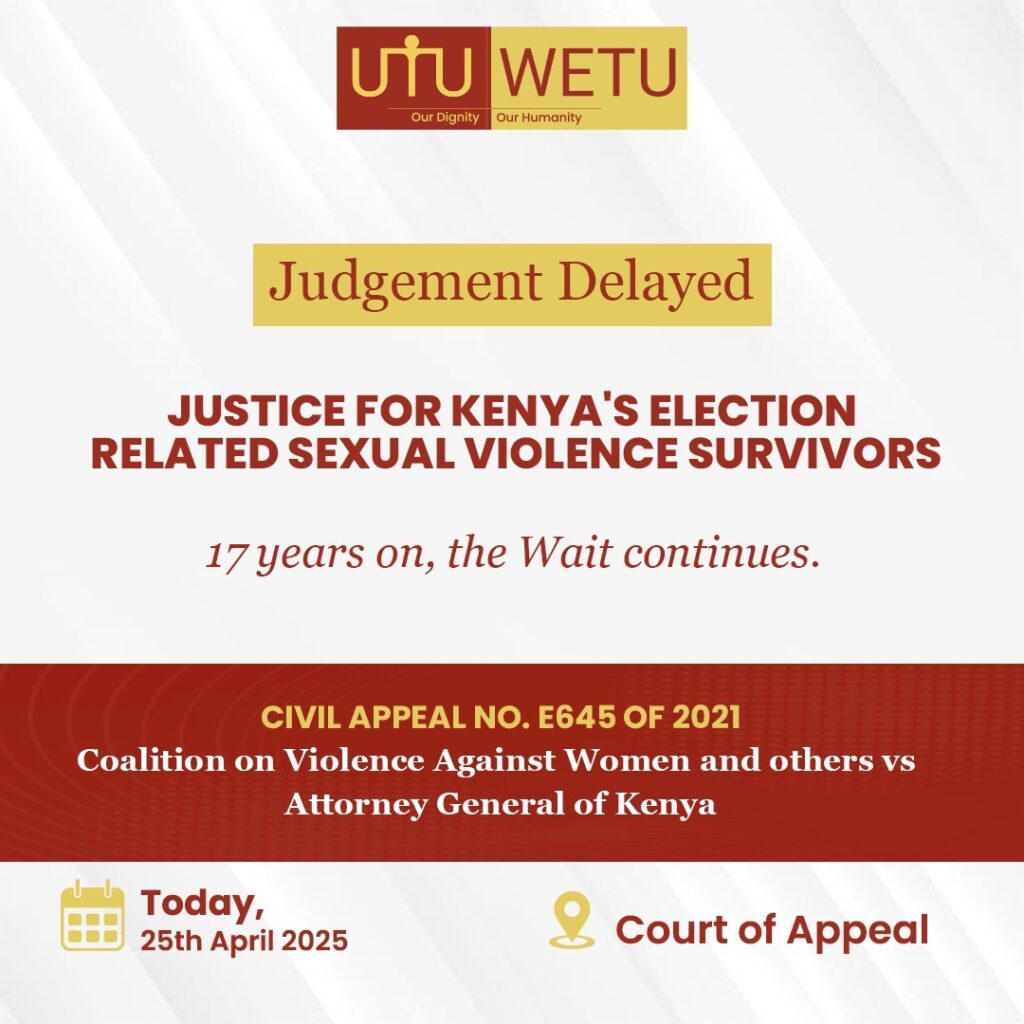
PEV Sexual Violence Appeal Judgment delayed yet again!

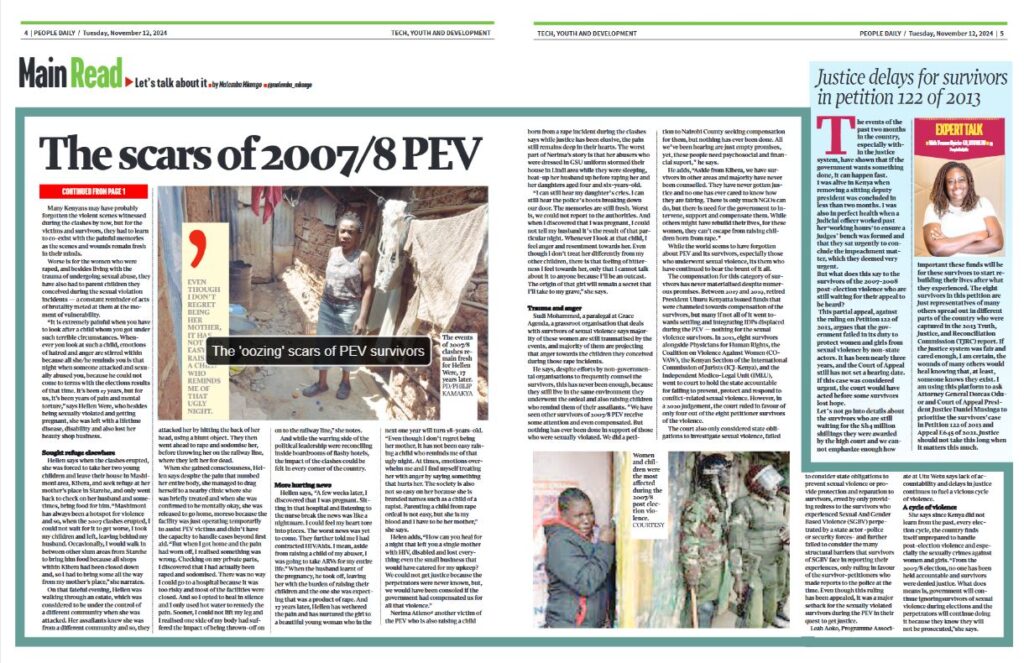
The victims and other parties in Appeal Case E645 of 2021 regarding sexual violence committed during the 2007-08 post-election violence are disappointed to learn this afternoon that the judgment has been delayed. This is despite being informed earlier this morning that the judgment would be delivered today. This follows an earlier postponement by the Court of Appeal on 11 April 2025. Cumulatively, the victims have been in court seeking justice for over 12 years. For the victims and survivors of the post-election violence, after more than 17 years, this is another dark day. We invite the media and Kenyans to interrogate the judiciary and the Government’s responses to the plight and rights of victims of gross human rights violations. As political deals are made, it is the victims who continue to bear the heavy and deep scars of political violence.

News, NEWSROOM

Media Highlights: Survivors Upset after Court Adjourns Judgment

When the Court of Appeal postponed its judgment, media outlets covered the development, focusing on the implications for the parties involved. Stories reported on the delay, highlighting the postponement’s legal, political, and social effects. Journalists interviewed key stakeholders, such as lawyers, victims, and activists, to present different views on the delay. Some media outlets also provided analysis on the decision’s potential impact on public trust in the judiciary, especially in cases involving high-profile or sensitive issues. These stories informed the public while they were awaiting the final verdict. The Star Newspaper https://www.the-star.co.ke/news/2025-04-11-post-poll-gbv-survivors-upset-over-deferment-of-verdict Ghetto FM Ghetto Radio Classic 105 Radio Jambo KTN  TV 47     https://twitter.com/Tv47Newske/status/1910761736208085414 Nyanza Review 17 years of haunting silence: Survivors of Kenya’s political violence demand accountability The Eastleigh Voice https://eastleighvoice.co.ke/poll%20violence/137397/court-delay-deepens-pain-for-2007-08-post-poll-gbv-survivors Mtaani Radio Bibilia Husema Broadcasting  

News, NEWSROOM

Statement: Court of Appeal Postpones Judgment in Election-Related Sexual Violence Case “17 Years On, Still No Justice and Reparation for Survivors”

  Nairobi, Kenya | 11th April 2025 The Court of Appeal has today postponed the delivery of its judgment in Civil Appeal No. E645 of 2021, a decision that has left survivors of sexual violence committed during the 2007-08 post-election violence disheartened and emotionally drained. For survivors who have waited 17 years for justice, this delay is more than procedural, it is deeply personal. It adds yet another layer of uncertainty to a legal journey already marked by prolonged silence and institutional disregard. The appeal case stems from Constitutional Petition 122 of 2013, which was filed in the High Court by eight survivors of sexual and gender-based violence (SGBV) experienced during the 2007–2008 post-election period, being six females and two males. Three of the female survivors were gang-raped by police officers while the other three females were gang-raped by civilian criminals, and the two male survivors, who were children at the time of the Post-Election Violence, were forcefully circumcised by ethnic militia. The survivors in the case are supported by a coalition of organizations, including the Utu Wetu Trust, Physicians for Human Rights (PHR), the Independent Medico-Legal Unit (IMLU), the International Commission of Jurists – Kenya (ICJ-K), the Coalition on Violence against Women (COVAW), Kenya National Commission on Human Rights (KNCHR), Kenya Human Rights Commission (KHRC), and the Constitution and Reform Education Consortium (CRECO). Two other organisations, Katiba Institute and REDRESS, are enjoined as Amicus Curiae in the case.   In 2020, the High Court issued its judgment in Petition 122 of 2013, awarding KShs. 4 million compensation to four of the survivor-petitioners on the basis that they were violated by police officers and for the State’s failure to investigate and prosecute perpetrators following one reported case where the survivor was raped by a civilian gang. The other four, whose cases involved gang rape and forced circumcision, were dismissed on the basis that they were committed by civilian perpetrators and lacked formal police reports. The Court of Appeal was today expected to address whether survivors violated by civilian criminals, and who did not or could not report violations, due to several factors including breakdown in security, law and order at the time, trauma, stigma, or displacement, still deserve protection and redress from the State. The Court of Appeal was also expected to address the High Court’s reluctance to issue structural orders that would require the State to establish mechanisms for documentation and reparation for all other victims of sexual violence committed during the PEV. You will recall that in 2008 the Commission of Inquiry into the Post-Election Violence, also known as the Waki Commission, recorded 900 cases of SGBV, which it termed as representing only “a tip of the ice-berg”. The Truth Justice and Reconciliation Commission went further to document thousands more of survivors of PEV-related SGBV in 2013. The appeal seeks the court’s intervention to ensure that the State identifies and provides mechanisms for reparation for all these victims, beyond the eight survivors participating in this specific case. These survivors are not seeking justice solely for themselves. They are standing up on behalf of many others, thousands across Kenya who continue to suffer in silence. Their pursuit of accountability is driven by a collective hope: that Kenya would recognize the full extent of pain, harm and disruption of lives caused by electoral violence and take steps to guarantee non-repetition. Instead of closure, survivors face persistent delay. The postponed judgement extends a legal process that began in 2013 and concerns violations from 2007. For 17 years, these individuals have navigated a legal system that has been slow to hear them, slower to act, and reluctant to fully confront the State’s failure to protect its citizens from sexual and gender-based violence. Adding to the gravity of this moment is the continued failure by the State to pay the KShs. 4 million compensation awarded by the High Court to each of the four survivor-petitioners in December 2020. A Certificate of Costs was submitted to the Ministry of Interior in August 2023, yet no payment has been made. The Ministry of Interior and the Office of the Attorney General have remained silent. Survivors are being forced to beg for what has already been granted to them by law. This adds onto the, almost KShs. 1 billion of unpaid compensation owed to survivors of the former Nyayo House Torture Chambers. This inaction reflects a broader institutional failure. In 2015, then-President Uhuru Kenyatta announced a KES 10 billion Restorative Justice Fund to address the plight of victims of the 2007-08 election-related violence. However, to date, this fund remains non-operational. Draft Regulations and a policy for implementation of the Fund have been sitting in the Office of the Attorney General, and the National Treasury, since 2017. They are yet to be adopted by the Cabinet or tabled before Parliament. Attempts by survivors and civil society organizations to engage the Office of the Attorney General have been unsuccessful, and survivors continue to wait, not just for funds, but for the  State to acknowledge their pain and suffering. Even more concerning are credible reports suggesting that a portion of the KES 10 billion fund may have already been disbursed, even though no public accounting has been made available. The reports indicate that Ksh 3.1 billion was allocated in the 2015/2016 budget. However, survivors and civil society remain in the dark about how these funds were disbursed, who the beneficiaries were, and what criteria guided the allocation, if any. We cannot talk about justice if transparency is absent.   While the State pleads budgetary constraints, we see lavish spending on political travel and campaigns, where public officials fly across the globe and traverse the country at enormous cost to the people of Kenya. These same public officials fail to act when it comes to compensating and providing holistic reparation to victims of gross human rights violations. There is no shortage of resources, only a shortage of political will. This delay is part of a pattern: Kenya has not reckoned

News, NEWSROOM

UTU WETU Speaks on Election-Related Sexual Violence on KTN News and K24 TV

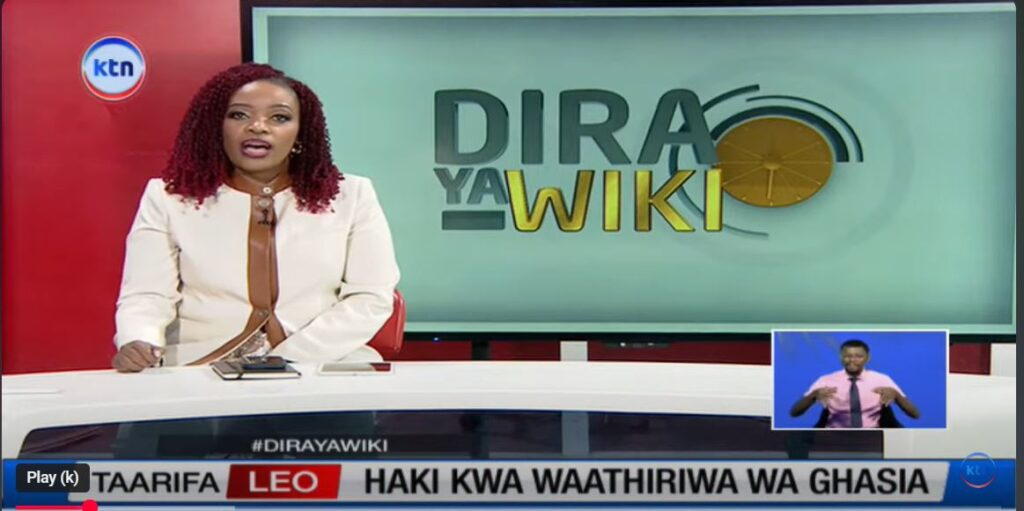
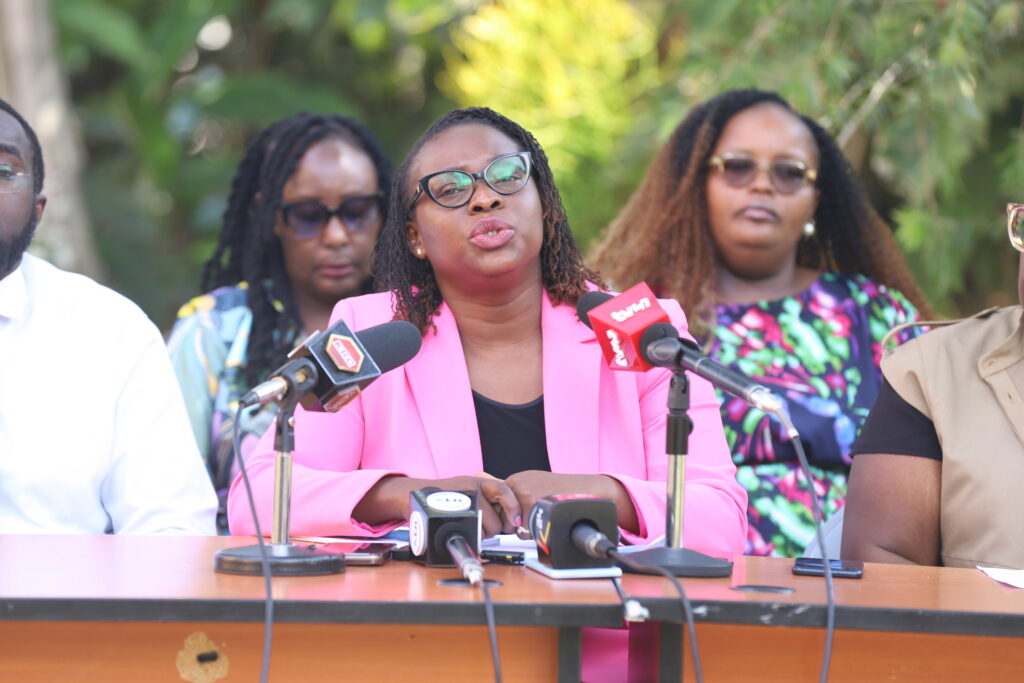
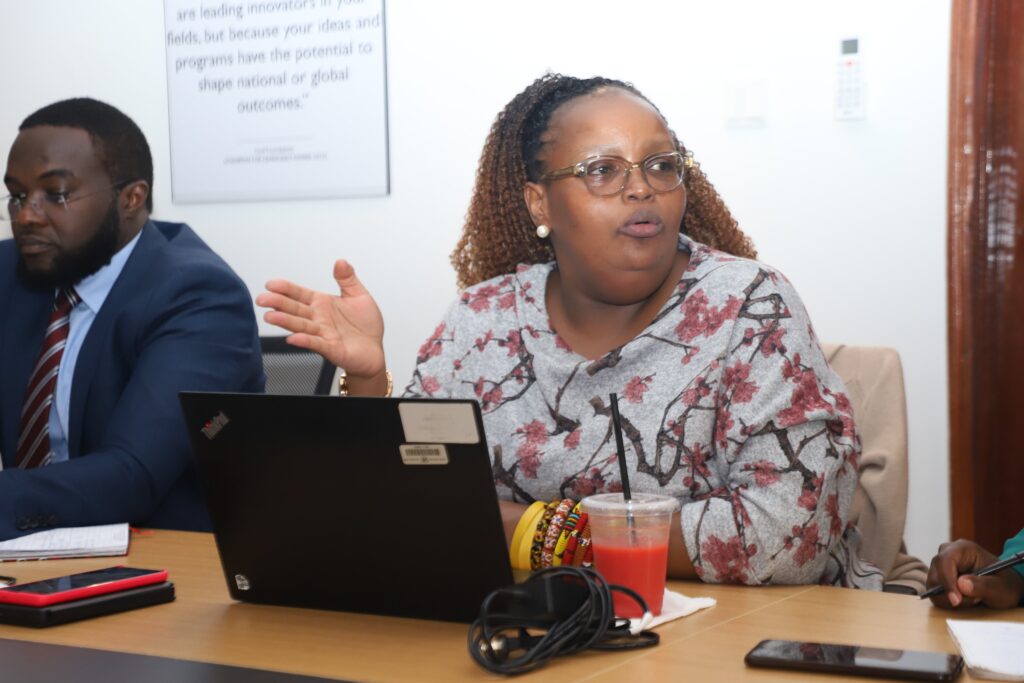
UTU WETU took part in two talk shows to raise awareness on election-related sexual violence and the need for government action. Our Trustee, Tina Alai, appeared on KTN News, and Leah Aoko represented the team on K24 TV. On KTN News, Tina Alai spoke about the experiences of survivors of election-related sexual violence. She explained that many survivors are still waiting for justice. Tina said that the government must take steps to support survivors and follow court rulings like Petition 122 of 2013. Leah Aoko spoke on K24 TV about the effects of election-related sexual violence. She said survivors need medical help, counselling, legal support, and public recognition. Leah also asked the government to fulfil its duty to provide support and justice to survivors. These interviews are part of UTU WETU’s efforts to push for action and support for survivors. KTN News interview with Tina Alai K24 TV interview with Leah Aoko

News, NEWSROOM

Editors Urged to Spotlight Reparations Fight as Court Ruling in Sexual Violence Case Nears

On April 7, 2025, editors from leading media houses gathered at the Kenya Human Rights Commission (KHRC) offices for a breakfast briefing on Petition 122 of 2013. The petition, filed in February 2013, seeks justice and reparations for survivors of sexual violence during the 2007–2008 post-election violence in Kenya. It was filed by six women and two men, supported by four organizations—the Coalition on Violence Against Women, Physicians for Human Rights, ICJ-Kenya, and the Independent Medico-Legal Unit. The Kenya Human Rights Commission later joined the case as an interested party. The petition was the first of its kind globally, aiming to hold the Kenyan government accountable for its failure to prevent, investigate, prosecute, and provide reparations for sexual violence committed during a period of conflict. <blockquote class=”twitter-tweet”><p lang=”en” dir=”ltr”>We’re meeting editors from media houses to brief them on justice and reparations for conflict-related sexual violence and broader human rights violations.<br><br>Our goal is to help them better understand survivors&#39; challenges and encourage more media focus on these issues. <a href=”https://t.co/FUar8FOukv”>pic.twitter.com/FUar8FOukv</a></p>&mdash; UtuWetu (@utu_wetu) <a href=”https://twitter.com/utu_wetu/status/1909147956441211019?ref_src=twsrc%5Etfw”>April 7, 2025</a></blockquote> <script async src=”https://platform.twitter.com/widgets.js” charset=”utf-8″></script> During the 2007–2008 crisis, survivors experienced severe acts of violence, including gang rape, sodomy, forced nudity, and forcible circumcision. In areas such as Kibra, Nakuru, and Naivasha, men were forcibly circumcised using machetes and knives, resulting in permanent injuries. Many of the perpetrators were police officers or members of organized groups, but victims were often unable to identify them. Despite a task force led by Hon. Dorcas Oduor reviewing over 6,800 cases, not a single sexual violence case proceeded to prosecution. Medical records were missing, police reports were unavailable, and victims were discouraged from seeking help. The court noted that the state had actionable intelligence and failed to take preventive measures. There were no emergency hotlines or evacuation plans, and victims were left to suffer in isolation. On December 10, 2020, the High Court ruled that the state had failed to protect some victims, particularly those harmed by state officers. Three women who were attacked by GSU officers received compensation of Ksh 4 million each. Another woman who was raped by civilians and reported the case to the police also received compensation because the state failed to follow up despite being aware. However, the court declined to hold the government responsible for violence committed by civilians, a decision the petitioners have since appealed. The appeal—Civil Appeal E645 of 2021—was heard on February 4, 2025, and judgment is expected on April 11, 2025. During the briefing, editors were informed about the broader context of state accountability in Kenya. Petition 122 was filed alongside other cases, including one on police shootings in Kisumu and another concerning internally displaced persons (IDPs). The outcomes in these cases have been disappointing. The courts ruled that the state did not fail in its duty during police operations, and many IDPs remain uncompensated. The failure to provide justice in these cases reflects a larger pattern of state impunity, visible from the Nyayo era, the 2007–2008 violence, the Baby Pendo case in 2017, and the more recent 2022 and 2024 protests. In all these instances, the state has not been held fully accountable, and victims continue to suffer without recognition or support. Although former President Uhuru Kenyatta publicly apologized to victims in his 2015 State of the Nation Address and established a 10-billion-shilling Restorative Justice Fund, the fund remains inactive. Reparation regulations were developed but have not been implemented, partly due to changes in leadership within the Attorney General’s office. Meanwhile, victims who were awarded compensation by the courts have not received payment, even though the Attorney General and the Ministry of Interior were served with certificates of costs. With every delay, the compensation owed to victims continues to accumulate interest at a rate of 14 percent annually. Wema Toywa, an editor from Ghetto Radio. See the story she published  below Survivors of 2007/2008 Post-Election Violence Anxiously Await Court of Appeal Ruling Slated for Friday

News, NEWSROOM

Survivors Demand Justice on Truth Day

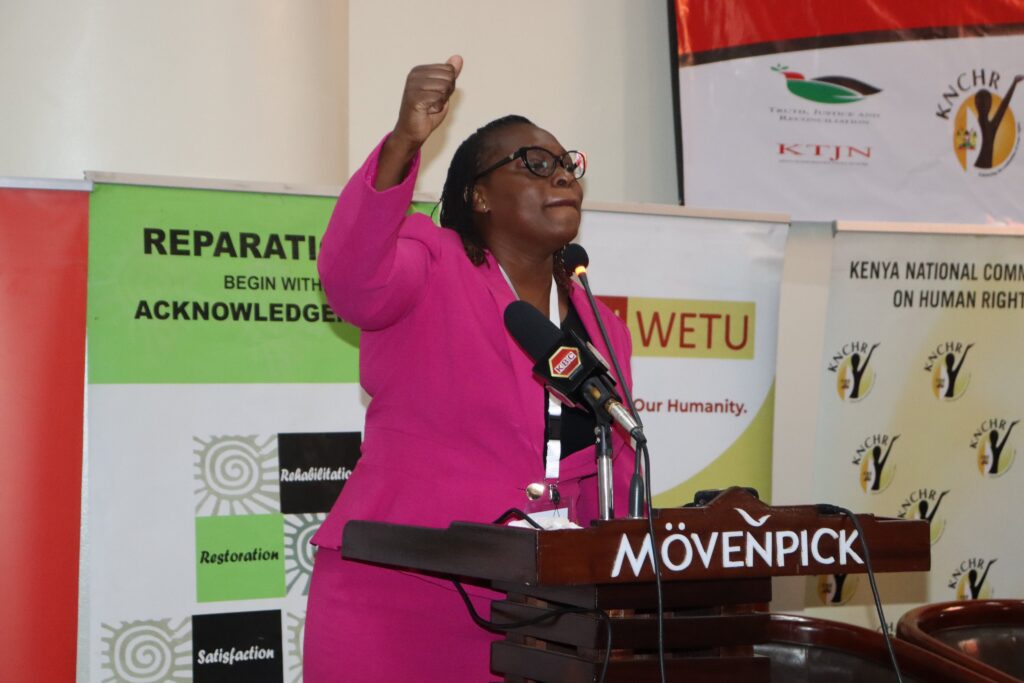
On March 24, 2025, different organizations and individuals came together at the Mövenpick Hotel in Nairobi to mark the International Day for the Right to the Truth concerning Gross Human Rights Violations and for the Dignity of Victims. This day was not just about remembering the past. It was a chance to speak directly to government and political leaders about the pain many Kenyans continue to carry. Survivors of human rights violations, including those harmed during post-election violence, gathered to ask the government why promises made years ago have not been fulfilled. One of the main topics was the KShs. 10 billion Restorative Justice Fund. This fund was announced in 2015 by the former president to help victims of the 2007–2008 post-election violence. Ten years later, the money did not reach those it was meant for. Victims are still waiting. The event also focused on the Truth, Justice and Reconciliation Commission (TJRC) report. The report gave clear recommendations for reparation. But since it was handed over to the government, no action has been taken. Some survivors have gone to court to demand justice. A case called Constitutional Petition 122 of 2013 took eight years before the court ruled. Four survivors were awarded compensation. But even now, the government has not paid them. Another appeal is ongoing, asking the court to recognize all survivors and make the government act. Those who attended included Senator Edwin Sifuna, who read a speech from Raila Odinga. Senator Okiya Omtatah was also present, alongside the victims’ lawyer, Willis Otieno. All of them spoke in support of the victims and the need for action from the government. At the event, survivors said they wanted more than words. They wanted action. They asked government officers to clearly state what steps are being taken to implement the justice fund, adopt reparation rules, and follow court decisions. The event also reminded people that if justice is delayed, more harm can happen. Without real steps, the country risks more violence, especially as the 2027 elections approach. The gathering ended with calls for everyone—government officers, political leaders, and citizens, to work together. Survivors want truth, justice, and compensation. They want their stories heard and their pain recognized. Journalists who attended the Event Aired the following stories in their respective media houses Radio Jambo Classic 105 The Star Newspaper https://www.the-star.co.ke/news/realtime/2025-03-24-explainer-understanding-international-day-for-truth-justice https://www.the-star.co.ke/news/2025-03-25-survivors-of-political-violence-break-silence-demand-justice https://www.the-star.co.ke/news/2025-03-25-raila-commits-to-defending-rights-of-election-violence-survivors#google_vignette Mount Kenya Times  “Reparation Now!”: Calls for Justice Echo on International Truth Day Inooro Tv Ramogi TV KBC K24   Nyanza Review Victims of 2007 Post Election Violence Raise Concerns Whilst Awaiting Justice   Ghetto Radio Honoring Victims & Defenders on International Right to Truth Day   Pear Radio pic.twitter.com/RhrqAYa7vk — UtuWetu (@utu_wetu) April 8, 2025  

News, NEWSROOM

Survivors and Activists Unite in Kibra to Demand Justice and Reparations

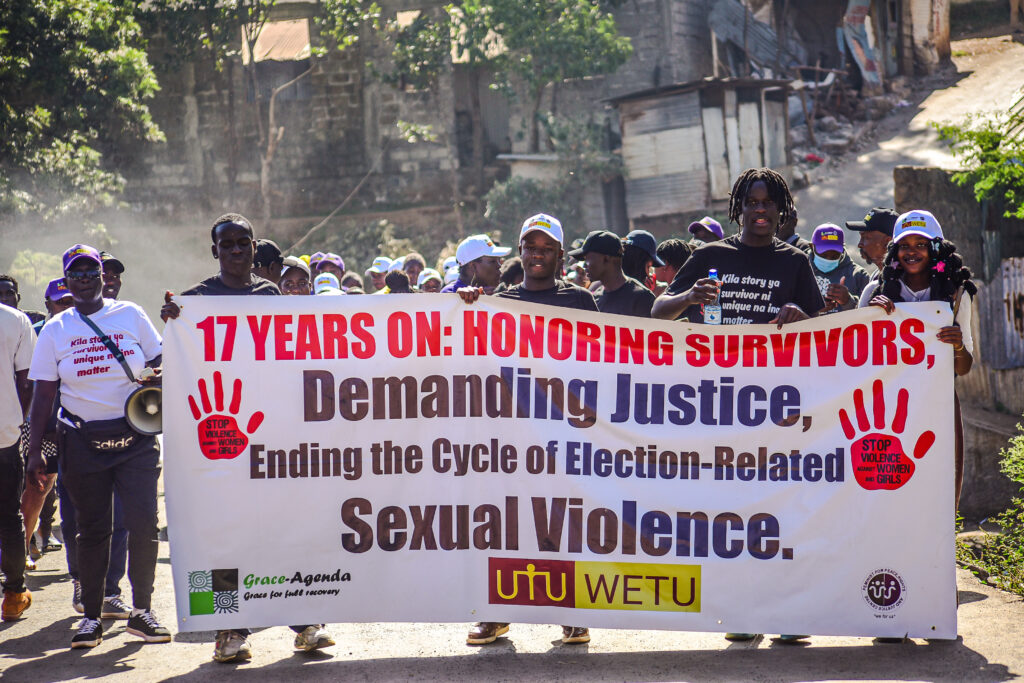
On Friday, February 28, 2025, the streets of Kibra came alive with the voices of resilience, courage, and determination. Survivors, activists, civil society organizations, and community members gathered for an advocacy March for Justice and Reparations, a call for accountability and redress for survivors of election-related sexual violence (ERSV). Organized by UTU WETU in collaboration with Grace Agenda and Feminists for Peace, Rights and Justice Centre, the march reminded people of the long-standing struggles for justice, particularly for women and children who have suffered due to electoral violence. Kibra, a symbol of struggle and resilience, has been a hotspot for electoral violence in Kenya. Seventeen years after the signing of the Kenya National Dialogue and Reconciliation Agreement, which promised justice and reparations for the 2007/08 post-election violence survivors, those commitments remain largely unfulfilled. This march amplified the call for justice for survivors, recognition of children born from sexual violence, and an end to cycles of impunity. The march began at Katwekera Village, with participants receiving t-shirts, caps, whistles, and placards emblazoned with the message: “Kila story ya survivor ni unique na ina matter” (Every survivor’s story is unique and matters). From Katwekera and Olympic to Koyaro Centre, survivors, activists, and duty bearers engaged with the community, demanding justice, reparations, and stronger protections against sexual and gender-based violence (SGBV). Speakers, including UTU WETU’s communications officer Henix Obuchunju, human rights defenders Cecilia May Ayot, Editah Ochieng, and Zuleika Yusuf, addressed participants on the way as they headed to Koyaro centre. key issues such as the impact of election-related sexual violence and impunity, the need for implementation of the Truth, Justice, and Reconciliation Commission (TJRC) and Waki Reports, the ongoing fight for justice in Petition 122 of 2013 and the upcoming court appeal judgement on April 11, 2025, the urgent need for gender-responsive budgeting to address SGBV effectively, and the increasing cases of femicide, with calls for it to be declared a national disaster were discussed. One of the most emotional moments of the day was the town hall meeting at Koyaro Centre, where survivors bravely shared their experiences. Editah Ochieng, a survivor and activist, recounted the horrors of gang rape and unsafe abortion, underscoring the deep trauma and lack of justice for many survivors. Zuleika Yusuf, a Nubian woman, shared how cultural norms forced her to endure 15 years of domestic violence, only finding freedom through the solidarity of fellow survivors. Other survivors, including Angela Nzilani, a visually impaired woman, and Wycliffe Wetende, a person with albinism, detailed the additional layers of discrimination and violence they endured. The testimony of a child born out of rape, who faced abuse and rejection, reminded everyone of the long-lasting impact of election-related sexual violence.         Representatives from government agencies, civil society, and law enforcement engaged in discussions with participants. Lynette Kitui from the State Department for Gender committed to strengthening referral pathways for GBV survivors. Lynette Kitui   Christine Owino from the Independent Policing Oversight Authority (IPOA) acknowledged the community’s mistrust in police accountability and called for better forensic evidence collection to aid prosecutions. However, survivors and activists emphasized that words are not enough, action is urgently needed to ensure justice is served. Our media partners covered stories from the march; check out their reports through the links below. Ramogi Tv The Star Newspaper  https://www.the-star.co.ke/news/2025-03-01-17-years-on-kibra-march-honours-survivors-of-poll-violence. Ghetto Radio  Ruben Fm   Ghetto FM Pamoja FM  https://pamojafm.co.ke/news/kibra-march-amplifies-call-for-justice-for-survivors/ Mtaani Radio Some of the survivors who spoke during the march were later invited to K24 to discuss the impact of rape. Zuleika Yusuf Sarah Dafala   

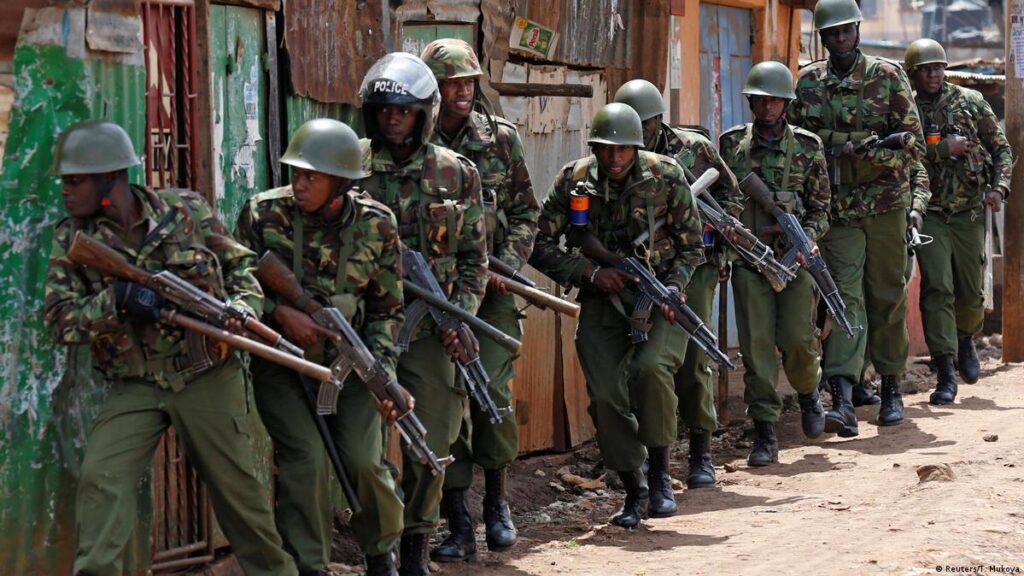
Image: Reuters/T. Mukoya
CASE 1: BABY PENDO, NEWSROOM

Doctrine of Command Responsibility: The Fight for Justice in Kenya’s Baby Pendo Case

Who should be held accountable when law enforcement officers or military personnel violate human rights? The individual who pulled the trigger, the officer who gave the order, or the entire chain of command that allowed such crimes to happen? International humanitarian law provides a clear answer through the doctrine of command responsibility. This legal principle ensures both direct perpetrators and their superiors are held accountable for law violations. This doctrine has been successfully applied in in international cases to prosecute war crimes, crimes against humanity, and genocide. For the first time in Kenya’s history, it is being used in the Baby Pendo case. Beyond the Officer on the Ground: The Chain of Accountability Under international law, command responsibility extends beyond the officer who commits an unlawful act. It holds law enforcement or military supervisors accountable if they fail to prevent or punish violations. The International Commission of Jurists Kenya emphasizes that this responsibility extends from the officer commanding a riot squad to the Inspector General of Police and even the Minister of Interior. Advocate Leah Aoko, a programs associate at Utu Wetu Trust, explains why this legal doctrine is critical in ensuring justice: “What we are saying is that where an offence has been committed by an officer, we hold the person who gave the orders responsible. For example, if I am part of a mission and I go to an area and commit an offence—whether it’s sexual assault—my boss is going to be held responsible.” She further highlights how this doctrine prevents a culture of silence within security forces. Police officers are often reluctant to report colleagues who commit crimes. However, when their superiors become liable for their actions, the entire chain of command must monitor and control what happens on the ground. “This can be very effective because police bosses will be aware of what their juniors are doing. If something wrong happens, they will be held accountable. They will be very keen to ensure that their juniors do not commit crimes. The issue of blindly following orders will come to an end.” Command Responsibility In Baby Pendo Case The Baby Pendo case is a reminder of police brutality in Kenya. In 2017, six-month-old Samantha Pendo was brutally beaten by police officers during post-election violence in Kisumu. She later succumbed to her injuries. This case was a turning point in Kenya’s human rights discourse, as it marked the first time that command responsibility was invoked to hold senior police officers accountable for the actions of their subordinates. The Independent Policing Oversight Authority (IPOA) investigated and recommended that the officers who carried out the violence and their commanders face prosecution under this doctrine. By applying command responsibility, Kenyan prosecutors seek to hold top security officials responsible for failing to prevent or punish the crimes committed by officers under their command. This is a step toward ending police impunity.  How Command Responsibility Works The concept of command responsibility is firmly embedded in the Geneva Conventions (1949) and Additional Protocol I (1977). The International Criminal Court (ICC) further solidified this principle in Article 28 of the Rome Statute, which defines two types of superior responsibility: Military Commanders – A commander is criminally responsible if they: Knew, or should have known, that forces under their command were committing crimes. Failed to take all reasonable steps to prevent or punish the crimes. Civilian Superiors – A non-military leader (such as a police commander or a government official) is responsible if they: Consciously disregarded information that indicated subordinates were committing crimes. Failed to act within their authority to prevent violations or report them for prosecution. In both cases, the superior does not need to order the crime directly. Their failure to act is enough to establish guilt. Why Command Responsibility Matters Now More Than Ever For decades, police and military abuses in Kenya have gone unpunished, often because perpetrators are shielded by a powerful hierarchy that protects its own. However, with growing calls for justice in cases of police brutality, enforced disappearances, and sexual violence, command responsibility could be a turning point. If successfully applied, it would send a strong message to police and military leadership: accountability does not stop at the junior officer. Every leader, from the commanding officer to the highest levels of government, is responsible for ensuring justice. By implementing command responsibility, Kenya has a chance to break the cycle of impunity—where powerful officials escape justice while survivors of violence are left to suffer in silence. The law is clear: failing to act is as much a crime as committing the act itself. Will  Baby Pendo Case Be the Landmark Kenya Needs? The Baby Pendo case is more than just one family’s fight for justice; it tests Kenya’s commitment to accountability. If the courts uphold command responsibility, it could change the way police brutality cases are handled in the country. But if the case persists, it will be another example of justice denied. Will Kenya uphold this principle, or will impunity continue reigning?

NEWSROOM

Court Halts Plea Taking in Baby Pendo Murder

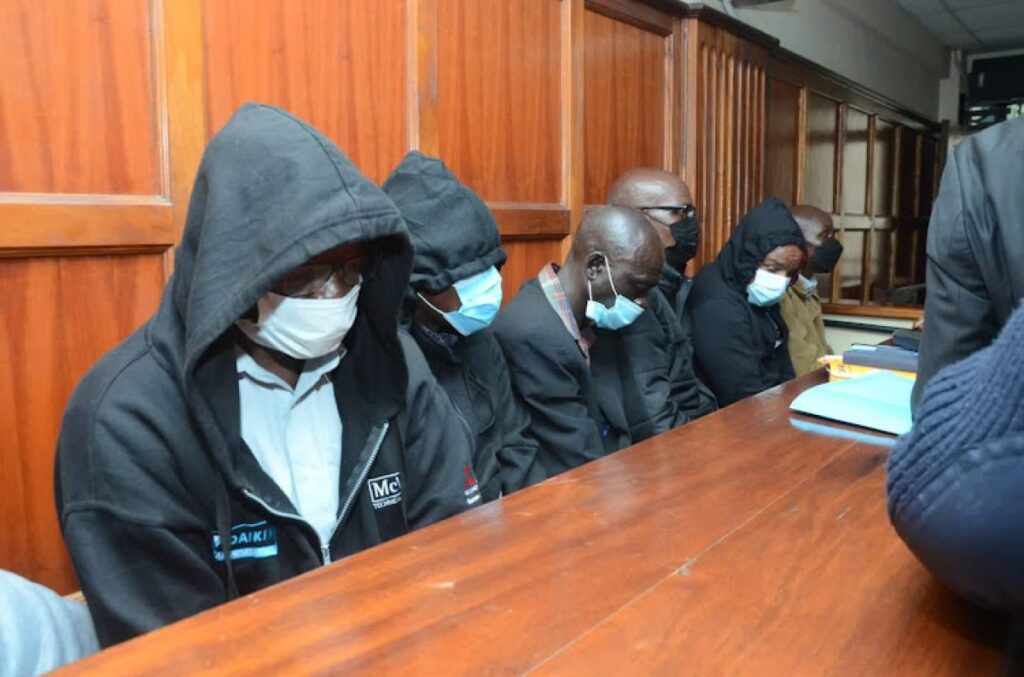
The Court of Appeal has halted the scheduled plea-taking for 11 police officers accused of murder, torture, and rape during the 2017 post-election violence in Kisumu. The Plea was scheduled for 3rd March 2025, before Lady Justice Margaret Muigai. This case,  a symbol of the fight for justice for six-month-old Baby Pendo, who was killed during a brutal midnight police operation, has been delayed once again following an appeal by the suspects. The officers, identified as Titus Yoma, Titus Mutune, John Chengo, Linah Kogey, Benjamin Koima, Benjamin Lorema, Volker Edambo, Cyprine Robi, Josphat Sensira, Mohammed Ali Guyo, Mohammed Baa, and James Rono, face 47 counts of crimes against humanity. They are accused of overseeing a violent crackdown that resulted in killings, torture, and sexual violence. Last month, the High Court ordered the prosecution to arrest the 11th suspect, Mohamed Baa, or remove his name from the case to allow plea-taking on March 3, 2025. However, the remaining officers moved to the Court of Appeal, arguing that the charges could cost them their jobs and livelihoods. On Wednesday, 26th February 2025, a three-judge bench comprising Justices Patrick Kiage, Weldon Korir, and Joel Ngugi granted a temporary proceedings stay pending their appeal ruling. Lawyer Willis Otieno, representing Utu Wetu on behalf of the victims, dismissed the appeal as baseless, pointing out that the trial had not commenced since plea-taking had not happened. “We shall deliver our ruling on March 21, 2025. In the meantime, the plea-taking scheduled for March 3 is hereby stayed. It is so ordered,” Justice Kiage stated. This decision marks another delay in a case closely followed by victims and human rights groups seeking accountability for the 2017 post-election violence in Kisumu.

News, NEWSROOM

Updates on the Hearing in the Petition 122 Appeal

The Court of Appeal, led by Justices Daniel Musinga, Francis Tuiyott, and George Odunga, today heard submissions in a partial appeal of petition 122 of 2013. The appeal, filed by seven survivors of the 2007-2008 post-election sexual violence alongside the Coalition on Violence Against Women, the Independent Medico-Legal Unit, the International Commission of Jurists, and Physicians for Human Rights, seeks state accountability for the failure to prevent, investigate, and prosecute cases of sexual and gender-based violence (SGBV) during the conflict. Represented by lawyer Willis Otieno, the petitioners argue that the state neglected its duty to protect victims and failed to provide justice, support, or reparations. Otieno criticized the earlier High Court ruling by Justice Weldon Korir, which limited compensation to victims abused by state officers while excluding those attacked by civilians. He asserted that the government bears responsibility for all victims, as it failed to act on intelligence reports, provide security, or address systemic failures that enabled the violence. The case, which stems from widespread sexual violence following Kenya’s disputed 2007 election, highlights the longstanding fight for justice by survivors. Human rights groups have documented hundreds of cases of rape, sexual torture, and other abuses perpetrated by both security forces and civilians. Despite various commissions, including the Truth, Justice, and Reconciliation Commission (TJRC), acknowledging the violations, many survivors remain without redress. Through Senior State Counsel Emmanuel Bitta, the government opposed the appeal, arguing that the incidents predated the 2010 Constitution and that victims who did not formally report their cases could not claim compensation. The Independent Policing Oversight Authority (IPOA) also distanced itself, stating it was established in 2012 and could not investigate prior violations. The petitioners, however, insist that justice cannot be denied based on procedural technicalities. They argue that victims’ medical records from Kenyatta National Hospital and reports from human rights organizations provide sufficient evidence. The case also seeks systemic reforms, including a national database for survivors and accountability measures against police officers implicated in SGBV during the violence. The court is expected to deliver its judgment on April 11, 2025, a decision that could set a crucial precedent for state accountability in cases of conflict-related sexual violence. Here are links to articles from journalists who reported on the court case. https://www.standardmedia.co.ke/national/article/2001511044/porn-video-interrupts-kenyan-court-hearing-of-post-election-sexual-violence-victims https://www.the-star.co.ke/news/2025-02-05-hackers-disrupt-virtual-court-hearing-with-adult-content https://www.youtube.com/live/-hz62zF7Otw https://pamojafm.co.ke/news/court-disrupted-as-judges-hear-appeal-on-post-election-sexual-violence/

Scroll to Top