NEWSROOM

News, NEWSROOM

Justice Postponed, Again

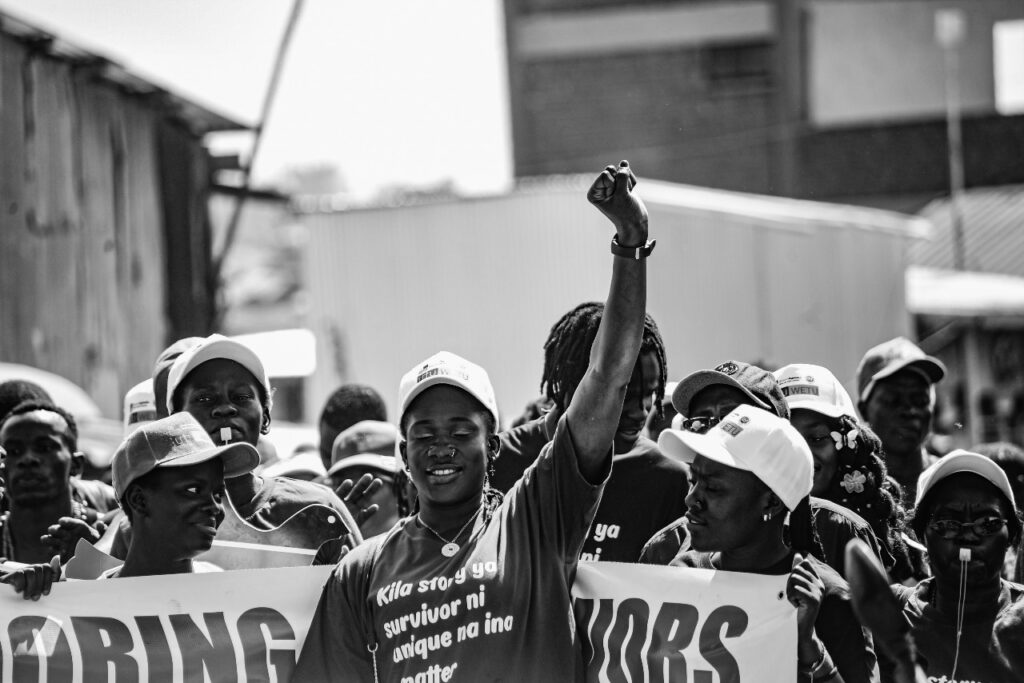
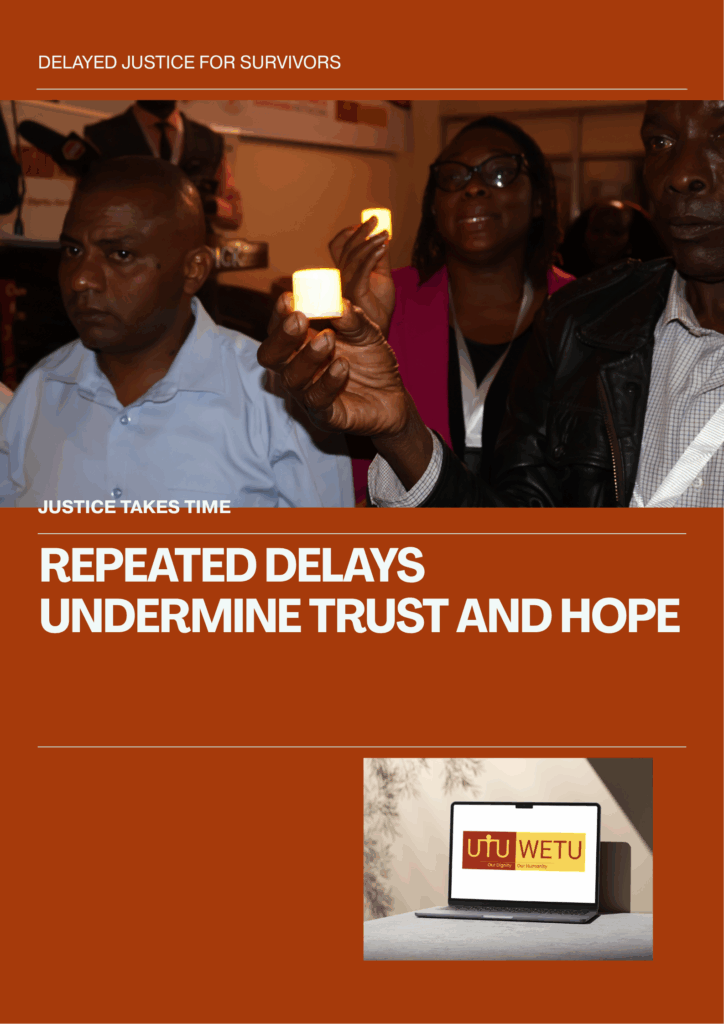
Truth is Justice is also about how long it takes to get there, right?  Recently, we’ve been seeing a repeated and familiar pattern. The Chebochok case, officially known as Constitutional Petition E006 of 2024, was expected to deliver a judgment this July. Survivors were waiting. Advocates were ready. But instead of a decision, we got a new date. The court has now pushed the judgment to 25th September 2025. Unfortunately, this isn’t the first time we’ve had to absorb such news. Take the partial appeal in Petition 122 of 2013, the case involving four survivors who’ve been fighting to hold the state accountable for the 2007/2008 post-election sexual violence. That judgment was expected in April this year. We’re now at the end of July, and there’s still no word and no timeline. Nothing to hold on to except silence. These are not just scheduling issues; when you zoom out, it becomes a clear pattern. Now, we’re not here to attack the courts. That’s not the point. But we won’t pretend this doesn’t matter either. Survivors walk into courtrooms with the full weight of memory, trauma, and truth. They give their statements and face questions. They sit through hearings and do their part. But time and again, they are met with postponements. And with every delay, the burden shifts, the system gets to pause, but survivors do not. They carry the silence. They carry the anticipation. They carry the pain of waiting for a judgment that keeps moving further away. At UTU WETU, we have stood with survivors from the beginning. We were there in court when these petitions were filed. We have walked alongside the survivors through each mention, each hearing, each false start. We have sat in those benches. We have felt the disappointment settle in the room when a judgment is deferred. Survivors have waited long enough. And while they continue to show up, we will continue to show up with them, recording these delays, making noise where we can, and refusing to go quiet. Because justice, especially for those who have waited this long, should not be rescheduled again and again without explanation.

News, NEWSROOM

Report: What Women in Kenya’s Tea Industry Are Going Through

The Coalition Against Sexual Violence (CASV), which includes Utu Wetu as one of its members, has released a new report that brings to light what women workers in Kenya’s tea industry go through each day. This study was conducted to collect stories from women who have experienced harm at work, to understand why these problems persist, and to examine the actions, or lack thereof, of those in charge to prevent them. Many people enjoy a cup of tea without knowing what happens behind the scenes. But for the women who work on tea farms and in tea factories, this cup of tea comes with a cost. Some women have been abused, others face unsafe conditions, and many are not given fair treatment under labor laws. This report explains what is happening, based on real stories from the women themselves. The goal of the study was not just to collect information, but to help bring about change. It examines the systems in place and how they fail to protect women. It also examines the culture in workplaces and communities that enables this harm to persist. Most importantly, it asks whether those responsible, including employers, state agencies, unions, and civil society, have the tools and the will to stop these violations and protect workers. The report is called “Analysis of Women Workers’ Experiences of Rights Violations in Kenya’s Tea Sector.” It includes findings from several regions in Kenya where tea is grown. It covers a range of issues: forced sex, unwanted touching, threats to lose jobs, long hours with no breaks, pay that does not match the work done, and a lack of support when workers report these issues. We’ve officially launched the study report “An Analysis of Women Workers’ Experiences of Rights Violations in Kenya’s Tea Sector.” Behind your tea are stories of exploitation, unsafe work and silence. Here's the link to the report https://t.co/1Zu3rmWXKy#ProtectTeaWorkers pic.twitter.com/rhHnSikwhm — Coalition Against Sexual Violence (@CoalitionAgSV) June 27, 2025 This report is not just about naming the problems, but also provides steps that can be taken to address them. These include better laws, stronger inspections, clear complaint systems that work, and more awareness among both workers and employers. It also calls for support systems that help survivors speak out and get justice. For those who believe that work should be safe and that no one should be harmed for doing their job, this report is an essential read. It asks tea companies to look at how their products are made. It calls on government offices to do their jobs. It also calls on the public to pay attention and speak out. Utu Wetu stands in solidarity with the women who shared their stories in this report. We will continue to advocate for action so that women in the tea sector, as well as in all workplaces, are treated with fairness, safety, and respect. You can read the full report here: Study Report – Women Workers’ Experiences of SEAH in Kenya’s Tea Industry FINAL_2025-06-23_01

News, NEWSROOM

International Day for the Elimination of Sexual Violence in Conflict and the Ongoing State Impunity in Kenya

Today, on the International Day for the Elimination of Sexual Violence in Conflict, Kenya must come to terms with the fact that the violence which erupted during the 2007 post-election period did not simply end with the cessation of fighting, but instead laid the foundation for a sustained and disturbing pattern of silence, denial, and impunity that continues to shape the relationship between the state and its citizens. During that time, women were subjected to rape and other forms of sexual violence, men were assaulted in ways meant to humiliate and destroy, and families were torn apart as the violence swept through communities already fractured by political tension. From these events emerged Petition 122 of 2013, a case built by survivors who refused to be forgotten, and who dared to ask the state to take responsibility not only for what was done to them, but also for what has never been acknowledged or repaired. Although a court ruling later confirmed that the state had failed to protect some of these survivors, no senior government or police official has been held accountable, and many of the individuals who inflicted the violence remain in service or silence, untouched by justice. In 2017, during the repeat presidential election, this cycle of violence continued in Kisumu, particularly in Nyalenda, where police officers raided homes in response to protests and public unrest. It was during this time that Baby Samantha Pendo, a six-month-old child, was killed in her mother’s arms after officers broke down the door and began attacking everyone inside. Her parents were beaten. Neighbors were assaulted. Women reported being raped by officers who came not to protect, but to punish. These events were not isolated, nor were they chaotic reactions to disorder—they followed a pattern that Kenya has seen before, where law enforcement agencies use moments of political contestation to carry out acts of violence with the assurance that they will not be held to account. Survivors from the Baby Pendo case came forward, gave testimony, and identified those who had harmed them, and yet today, years later, the legal process drags on. At the same time, those most responsible remain in positions of authority, facing no real consequences for their actions. In 2025, a new wave of protests, led largely by young people often referred to as Gen Z, has brought the unresolved legacies of the past back into focus. These young protesters are taking to the streets to demand answers about public debt, taxation, economic inequality, and the cost of living. Still, they are being met with the same tools of repression that were used in 2007 and 2017—live bullets, arbitrary arrests, disappearances, and physical violence. What is striking is not simply that violence is being used again, but that it is being used in the exact locations, against the same communities, with the same methods, as if nothing has been learned, as if the state sees no need to change. These are not just security operations gone wrong. They are deliberate actions taken against unarmed civilians whose only demand is to be heard. The continuity of state violence from one election cycle to another, and now from elections to peaceful protests, suggests that impunity has become embedded in the culture of governance and that institutions meant to protect rights have either collapsed or been compromised. It is within this broader context that UTU WETU continues to walk alongside survivors, those who were violated during the 2007 post-election period, those who were harmed in 2017 during the Baby Pendo operation, and those who are now facing repression for simply raising their voices in protest. We believe that justice must go beyond court rulings and statements of concern. It must involve the actual prosecution of those who planned and executed these acts, the full implementation of court decisions such as the one delivered in Petition 122, and a thorough reform of the institutions that have repeatedly been used as instruments of violence rather than protection. Survivors should not be forced to relive their trauma through endless delays and broken promises. Communities should not have to mourn new victims before old wounds have even begun to heal. The state cannot continue to shift blame, postpone responsibility, or treat each wave of violence as if it has no connection to the one before. Until it is willing to confront the truth of what has happened, to name the individuals responsible, and to act on behalf of those it has failed, the cycle will not end. The names will change. The faces will change. But the pain, the fear, and the silence will remain. On this day, we do not just remember. We demand. We demand that the state recognize the full spectrum of violence that has occurred over time, that it stops treating sexual violence as a footnote in conflict, and that it begins the long, necessary process of restoring trust, dignity, and justice to the people it was meant to serve.

News, NEWSROOM

Thank You to the Media for Standing with Baby Pendo

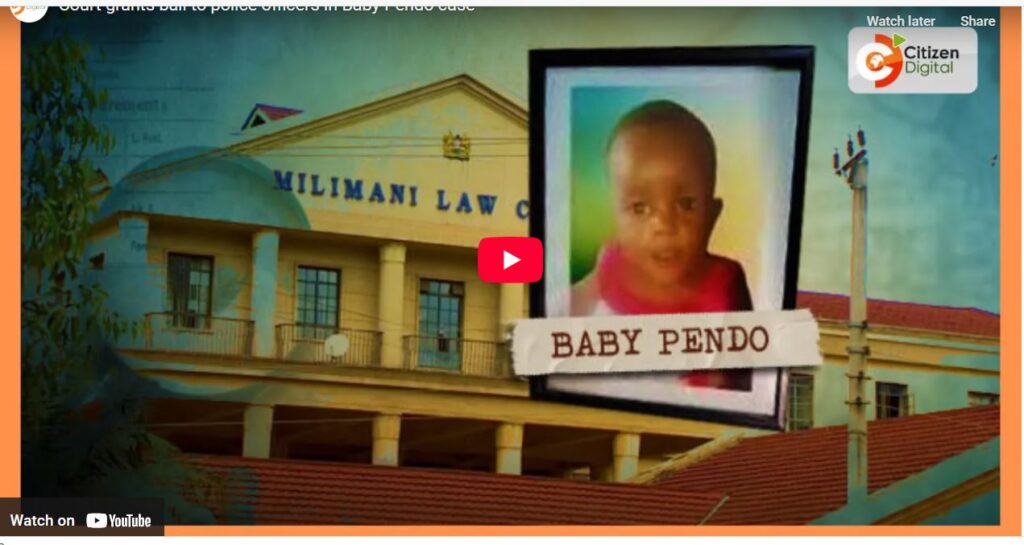
We want to take a moment to sincerely thank all the journalists and media outlets that continue to walk this journey of justice with us. Your consistent reporting and unwavering interest in the Baby Pendo case have not only kept the public informed but have also ensured that the struggle for justice for victims of police brutality is not forgotten. On June 16th, during the High Court’s ruling on bail for the accused officers, we saw an encouraging wave of media attention. Stories were aired, articles were written, and voices were raised to demand accountability and truth. The media’s coverage helped amplify the pain, the progress, and the power of survivors and affected families. We appreciate every journalist who has stood in courtrooms, filed updates late into the night, and given space for victims’ voices to be heard. Your work matters. These are not just court cases; they are stories of lives disrupted and a country trying to reclaim its soul through the pursuit of justice. Here are just some of the stories published during the June 16th bail ruling: Citizen TV   https://www.citizen.digital/news/four-cops-charged-in-baby-pendo-murder-case-granted-ksh1m-cash-bail-each-n364721 The Eastleigh Voice https://eastleighvoice.co.ke/national/165596/four-officers-linked-to-baby-pendo-murder-case-released-on-sh1-million-bond The Standard https://www.facebook.com/standardkenya/posts/baby-pendo-murder-suspects-freed-on-bailhttpswwwstandardmediacokenationalarticle/1161846932651775/ Nairobi Leo https://nairobileo.co.ke/news/article/21336/high-court-issues-new-directive-on-4-police-officers-in-murder-of-baby-pendo We urge our audience to continue following these developments, engaging with the coverage, and supporting calls for accountability. The journey is far from over, but with your continued support, we move one step closer to justice.

News, NEWSROOM

Update on Court Proceedings in Baby Pendo Case

The  Milimani High Court, Criminal Division, presided over by Hon. Lady Justice Margaret Muigai, has today delivered directions in the ongoing case of the Republic vs. James Rono & Mohamed Baa & Others (Milimani H.C.C.R Case No. 074 of 2022), commonly known as the Baby Pendo case. The court addressed three key matters during the sitting: the grant of bail to four accused persons, the enforcement of warrants of arrest against the 11th accused person, and an application by victims’ counsel related to the same. 1. Court Grants Bail to Four Accused Persons The court granted bail to four accused police officers in the case. Each accused person is required to deposit a cash bail of KES 1,000,000 and secure two sureties of KES 500,000 each. The court also retained and emphasized several non-financial conditions, which had been issued in earlier rulings. These include: Prohibition from contacting or interfering with victims, witnesses, or any form of evidence; Prohibition from visiting the identified crime scenes in Kisumu; Requirement to remain within the jurisdiction of the court throughout the duration of the proceedings; Obligation to attend all court sessions without fail; Surrender of passports to the court; Mandatory quarterly reporting to the nearest office of the Independent Policing Oversight Authority (IPOA). The court indicated that these conditions are necessary to ensure that the proceedings are not compromised and that the safety and participation of witnesses and victims are protected throughout the trial. 2. Court Discusses Status of the 11th Accused Person The court also addressed the ongoing absence of the 11th accused person, Mr. Mohamed Baa, who has not appeared before the court since charges were preferred. Previous arrest warrants had been issued by the court beginning in 2022. The National Police Service (NPS) has reported conducting two search operations at residences known to be associated with Mr. Baa. During the proceedings, the court clarified that the warrants of arrest against Mr. Baa are still active. 3. Application by Victims’ Counsel on Public Assistance in Enforcement Following the court’s affirmation that the warrants remain in force, victims’ counsel made an application requesting that the court issue further directions to the National Police Service. Specifically, the counsel urged the court to direct NPS to enlist public assistance in the ongoing effort to locate and arrest Mr. Baa. This application was made in light of the extended period during which the warrants have been executed and growing concerns among victims regarding their safety and access to justice. The victims’ application was supported by reference to existing court orders and the victims’ legal right to participate in proceedings free from fear or intimidation. The court noted the application and indicated that it would deliver a ruling on the matter on July 2, 2025. 4. Next Steps in the Case The court has directed all parties involved in the case to prepare for pre-trial proceedings in line with standard criminal trial procedures. Pre-trial engagement is expected to cover matters such as scheduling, disclosure, witness protection measures, and case management. The court further directed that the names of survivors and sensitive personal information be redacted from documents displayed on the Case Tracking System (CTS), in compliance with privacy and protection obligations under Kenyan law. UTU WETU Trust remains committed to supporting the victims and survivors involved in this matter. As the case progresses, we will continue to walk alongside them, ensuring they are informed, heard, and able to participate in the judicial process through the appropriate legal and psychosocial support frameworks provided under the law

News, NEWSROOM

Utu Wetu Joins Feminists for Peace to Support Change in Kibra

Utu Wetu was honoured this week to join  Feminists for Peace, Rights and Justice Center at a graduation ceremony held at their community space in Kibera. The event brought together survivors of sexual and gender-based violence, sex workers, queer persons, and young men, each of whom had completed a training program on financial literacy and understanding gendered harm in our communities. As an organisation rooted in advancing survivor-led justice and pushing for state accountability in addressing sexual and gender-based violence (SGBV), we were glad to be part of this moment. The graduation is a reminder that justice is not only found in courtrooms. It must also be felt in the lives of people who rebuild from harm and find power in economic independence. Sixteen individuals completed the program and received business toolkits to help them start or expand small businesses. These were not just items. They were tools to support the agency. They were part of a bigger response, one that links economic empowerment to healing and long-term safety. At Utu Wetu, we continue to call attention to the failure of state systems to protect survivors and prevent violence. But we also believe in what communities can build while demanding justice. We are proud to stand with Feminists for Peace and others who are creating spaces where survivors are not only supported but also trusted to lead. During the ceremony, Utu Wetu’s Communications Lead, Henix Obuchunju, joined in handing over business toolkits to the graduates. One of the gifts, a commercial blender, was given to a survivor who plans to start a small juice business in her neighbourhood. For her, and many others like her, this gift marks a new chapter, one where survival is not the end goal, but the beginning of building a life with stability and purpose. These kinds of tools are practical steps toward financial independence and self-reliance. They help survivors reclaim control over their daily lives, make choices that suit their needs, and reduce dependence on exploitative systems or unsafe environments. We recognise that real justice includes access to income, to safety, and to platforms where voices are heard and believed.

News, NEWSROOM

Survivors of Petition 122 Receive Psychosocial Support and Case Update

On 30th May 2025, eight survivors from Petition 122 of 2013 attended a psychosocial support session held at the Physicians for Human Rights (PHR) offices in Nairobi. The session was part of ongoing support for survivors who are part of the court case seeking justice for police violence during the 2013 post-election period. During the session, the survivors received an update on the progress of the petition. The legal team shared information on the current status of the case and what to expect next. The session was facilitated by Salima Macharia, a counselling psychologist. She guided the survivors through a session focused on emotional wellbeing and ways to manage stress. Survivors also shared their experiences and reflections. These sessions are designed to ensure survivors are informed and supported as they continue their journey for justice. The space also allows them to connect and support each other. UTU WETU continues to stand with survivors in their pursuit of accountability and redress.

NEWSROOM

Court Declares Out of Court Settlements in Sexual Violence Cases Unconstitutional

On December 15, 2023, the High Court in Nairobi delivered a judgment that addresses the legal position of out-of-court settlements in cases involving sexual violence. In Constitutional Petition E416 of 2021, the court held that agreements that prevent the prosecution of suspects in sexual violence cases are unconstitutional and unlawful. The case was filed by IW and the Centre for Rights Education and Awareness against four respondents, including a former employer, a police officer, the Inspector General of Police, and the Attorney General. The first petitioner, a university student, reported that she was sexually assaulted by her employer after being instructed to report to a different branch of his business. After disclosing the incident to her partner, she reported the matter at Mlolongo Police Station. The investigating officer advised her to report the location of the incident as Syokimau and not Madaraka. The officer also directed her to undergo medical tests at a hospital. The medical report confirmed sexual contact, and forensic evidence was collected. The first petitioner stated that the investigating officer later suggested she enter into a financial settlement with the suspect. She said she was asked to modify her statement and to accept a sum of money to avoid forwarding the case to the Director of Public Prosecutions. According to the petition, she agreed to receive one hundred and thirty thousand shillings in four installments. The officer took a photograph of the written agreement but did not allow anyone else to keep a copy. Payments were made in part, and a portion of the money was transferred to the officer. The petitioners asked the court to declare that the police had failed in their duty to investigate the matter and protect the rights of the first petitioner. They sought a declaration that the out-of-court agreement was coerced and that the police and the state had violated the rights of the survivor under the Constitution and international law. They also requested that the court compel fresh investigations, impose sanctions on the officer involved, and award compensation. The respondents argued that the petition should have been addressed through the Internal Affairs Unit or the Independent Policing Oversight Authority. The court rejected that argument, stating that those bodies do not have the mandate to offer constitutional remedies or compensation. The court found that the High Court had the proper jurisdiction to determine the matter. The court stated that police officers do not have the legal power to initiate or approve out-of-court settlements in sexual offence cases. That power rests only with the Director of Public Prosecutions, as outlined in section 40 of the Sexual Offences Act and article 157 of the Constitution. The court also stated that such agreements infringe on the rights to equality, dignity, and freedom from violence under articles 27, 28, and 29 of the Constitution. They also violate international instruments that Kenya has ratified, including the Universal Declaration of Human Rights, the Convention on the Elimination of All Forms of Discrimination Against Women, the International Covenant on Civil and Political Rights, and the Maputo Protocol. Although the court found that the existence of the out of court agreement was not proved to the required standard, it issued two declarations first, that any agreement in sexual violence cases that results in the non prosecution of those who may be responsible is unconstitutional. Second, that police officers are not allowed to enter into or approve such agreements unless directed by the Director of Public Prosecutions acting within the Constitution and the law. The court declined to issue the other orders requested, including compensation and sanctions, and directed each party to bear its own costs. The judgment addresses how police handle sexual offence cases and clarifies that informal settlements are not a legal option in cases involving allegations of rape or sexual violence. It provides direction to law enforcement, survivors, and civil society on the proper procedure for dealing with such cases. It reinforces that investigations must follow the law and that any decision to stop a prosecution must come from the office of the Director of Public Prosecutions. The judgment also highlights the role of the courts in interpreting the Constitution and enforcing accountability when institutions fail to act in line with legal standards. For groups that provide legal and psychosocial support to survivors, this judgment serves as a reference point in challenging practices that undermine access to justice. It also underscores the need to document and preserve evidence in cases of abuse. Although the court did not grant all the reliefs requested, the declarations made set a legal standard that prevents the use of informal agreements to settle criminal offences related to sexual violence. The court has stated that sexual violence is a matter for prosecution, not negotiation. The law does not permit informal resolution of such cases through monetary payment or private arrangements. This judgment will influence future cases and shape how victims of sexual violence are treated in police stations and in the justice system. Find the full judgment here

News, NEWSROOM

30 HUMAN RIGHTS ORGANISATIONS CONDEMN WITHDRAWAL OF CHARGES AGAINST 8 OF 12 SUSPECTS IN BABY PENDO CASE

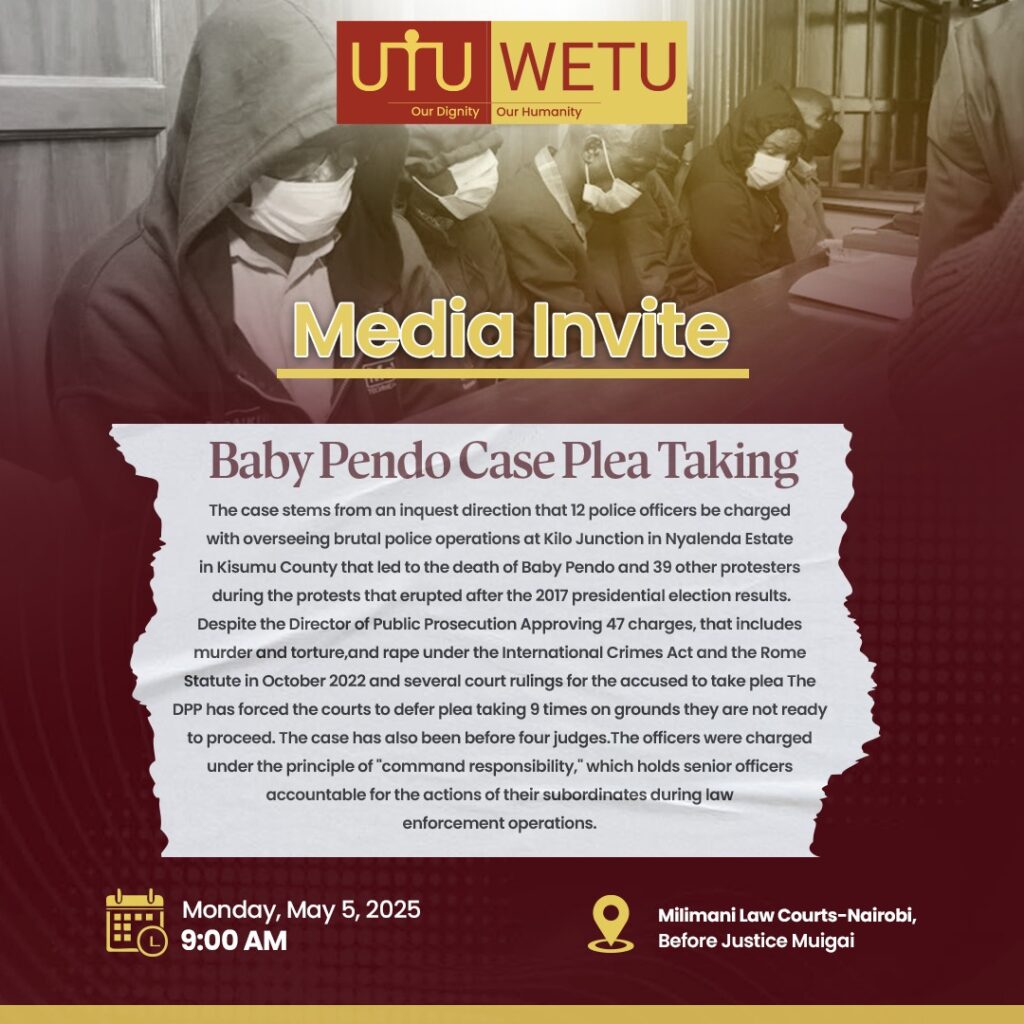
     Nairobi, 5 May 2025: Victims’ families, Amnesty International Kenya, Utu Wetu Trust, the International Justice Mission, and the Police Reforms Working Group condemn the DPP’s dropping of charges against eight of the twelve police commanders and officers who were initially included in the original charges. Today, four police officers took plea before the High Court of Kenya for charges of crimes against humanity, including murder, rape and torture committed against civilians during the 2017 elections, under the International Crimes Act. The charges include the brutal murder of Baby Samantha Pendo, the rape and indecent assault of women and girls in Kisumu, and the torture of many others during the 2017 election violence period. The plea-taking occurred more than two years after the case was lodged by the Office of the Director of Public Prosecutions (ODPP) in 2022, following repeated adjournments and delays. The latest twist follows ten applications by the accused police officers’ defence counsel and the DPP to defer plea-taking against the original twelve officers. Furthermore, as stated in court, the charge sheet was amended without the involvement of the Independent Policing Oversight Authority (IPOA), the investigating agency in the case. The charge omits senior police officers who held overall command responsibility during the operations that saw the deaths, rape and injuries of no less than 60 Kenyans in Kisumu County. We are also deeply concerned that, contrary to the ODPP’s protection obligations, the charge sheet, which is now public, contains the names of victims and witnesses. This public identification has the potential to expose the victims and witnesses to possible harm and reprisals and could jeopardize the case against the four officers. We urge all parties to adhere to the court’s order to mitigate harms to the victims in accordance with the Victims Protection Act. In this regard, we call on all parties and the media to redact the names of the victims and witnesses in further proceedings and reporting. Both state and non-state actors must take all measures to ensure that the victims and witnesses in this case are not subjected to the same risks experienced by those involved in the cases before the International Criminal Court concerning the 2007-08 post-election violence. The consistent attempts to defer or stall proceedings in this case, alongside the recent withdrawal of charges against eight police commanders who were initially included in the charge sheet, have deeply betrayed the interests of the victims and the broader public. These actions risk undermining the pursuit of justice and reinforcing a culture of impunity within the security services. We, therefore, urge the judiciary to ensure that the cases against the four police officers who took a plea today are expedited. The victims and families of Baby Pendo and the many others who suffered at the hands of police officers urgently deserve justice and reparation to have closure and move on with their lives. Signed Irungu Houghton Amnesty International Section Director Vincent Chahale, International Justice Mission-Kenya Country Director Christine Alai Co-founder- Utu Wetu Trust  

News, NEWSROOM

Tales of Survivors of election related Sexual Violence

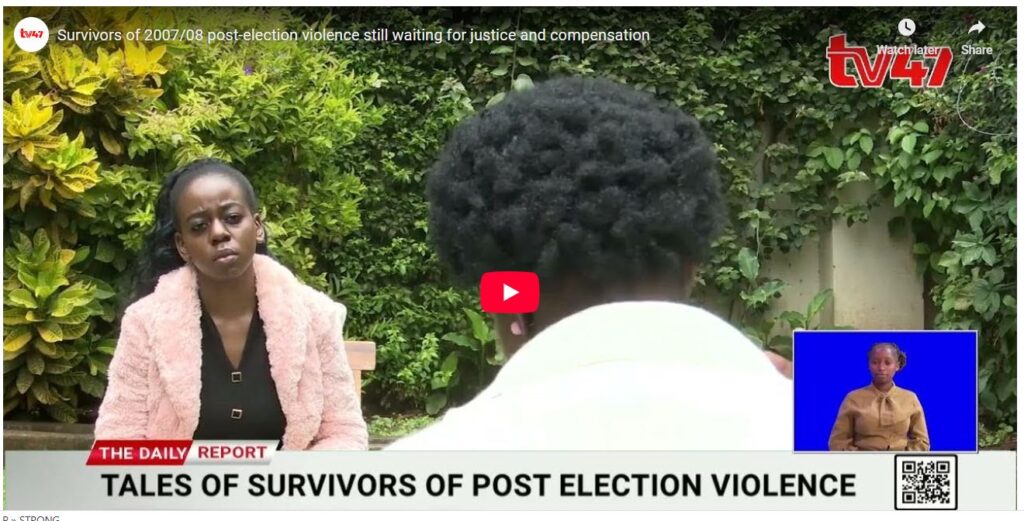
We recently engaged the media to share the powerful stories of survivors of election-related sexual violence. These stories were documented on K24 and TV 47, highlighting their ongoing struggles. As four survivors await compensation and another four await judgment in Petition 122 of 2013, their resilience continues to inspire. We encourage you to watch these stories, underscoring the urgent need for justice and accountability. TV47 K24  

Scroll to Top