NEWSROOM

News, NEWSROOM

BABY PENDO CASE: UTU WETU TRUST And Other Victims’ Lawyers Appear in Court as Fresh Directions are Issued

Utu Wetu Trust appeared before the Kisumu High Court on 28 September 2026 alongside other lawyers representing victims in the Baby Pendo matters. Senior Counsel Paul Muite appeared as Lead Victims’ Counsel, alongside Utu Wetu Trust counsel Willis Otieno and Dr. Owiso Owiso, as well as representatives from Amnesty International, the International Justice Mission, the Kenya National Commission on Human Rights, the Law Society of Kenya, and the Independent Medico-Legal Unit, among others. CONSTITUTIONAL PETITION | KISUMU H.C. CONSTITUTIONAL PETITION NO. E011 OF 2026 In Lenser Achieng, the mother of Baby Samantha Pendo (deceased) & 49 Others v Director of Public Prosecutions; Benjamin Kipkoskei Koima & 12 Others (Interested Parties), the Court considered the status of responses to the petition and to the application dated 12 April 2026 seeking the empanelment of a three-judge bench. The Court heard that only three of the seven interested parties had filed responses to the empanelment application. The respondents indicated that they did not oppose the application, while some interested parties opposed it and others sought additional time to file their responses. The Court granted interested parties who had not yet filed their responses 14 days to file and serve them. The petitioners will thereafter have 14 days from receipt of the final response to file and serve a further affidavit. The Court emphasized that these timelines are not subject to extension. The matter will come up for further directions on 23 November 2026 at 2:30 p.m. CRIMINAL CASE | KISUMU H.C. CRIMINAL CASE NO. E032 OF 2025 In the related criminal case, Republic v. John Chengo Masha and Linah Kogey & 2 Others, the victims’ legal team raised two outstanding issues before the Court. First, Senior Counsel Paul Muite noted that an earlier court direction requiring the removal of Annexure JCM 1 from the court’s case tracking system had not been complied with. The Court directed the Deputy Registrar to ensure that the order issued on 15 July 2026 is served on the Registrar Automation and complied with within seven days, with confirmation of compliance to be provided to the Court before the next mention date. Second, the victims’ legal team raised the issue of the full statement of the 3rd accused person, which had not been served on the victims’ counsel. The prosecution acknowledged that the complete statement had not been re-served and attributed the failure to an oversight. The Court directed that the complete statement of the 3rd accused person be re-served to all parties within seven days. The criminal matter will also come up for mention on 23 November 2026 at 2:30 p.m. Utu Wetu Trust remains committed to supporting victims and their families in the pursuit of justice, accountability, and effective access to justice.  

NEWSROOM

Awino: The Writing Is on the Wall, Are We Paying Attention?

By Joyce Joyce Awino Ochieng    It is 10th August 2027. The votes have been cast. Counting is underway. Millions of Kenyans are glued to their screens, waiting for the results. Is the air tense? Is the country calm? Does the uncertainty give way to tension, fear, and a descent to violence and anarchy? Or does it yield to restraint, confidence in the electoral process, and stability? In these critical hours, one question hangs over the country—was the writing on the wall? The answer to this question lies in the days long before the first vote was cast. The manner in which Kenyans navigate the period between the voting and declaration of results determines the events that follow, whether peaceful or otherwise. We have seen the signs before. Kenya has had a history of electoral-related violence since the establishment of multi-partyism in 1991. During the 2005 constitutional referendum campaign, the Kenya National Commission on Human Rights documented incitement and hate speech and called for the investigation and prosecution of 16 sitting and former Members of Parliament. Human Rights Watch later recorded that none of them were investigated or prosecuted. The pattern continued into the 2007 election period. Just before the elections, the Kenya National Commission on Human Rights published a report—Still Behaving Badly, a second report under its elections monitoring project that began in October 2007. The report documented the misuse and diversion of public resources, involvement of public officers in political campaigns, incitement and acts of violence, and the use of hate speech by the media and politicians in targeting individuals and communities along gender and ethnic lines. A Human Rights Watch report dubbed Ballots and Bullets: Organized Political Violence and Kenya’s Crisis of Governance recorded significant violence in Kuresoi, Molo, and Mt. Elgon in the months preceding the 2007 election, resulting in about 200 deaths and 70,000 displacements. In those areas, political competition had already been intertwined with ethnic mobilization and organized violence, a troubling indication of the violence that would later engulf the country. Several leaders were implicated, while some persons of interest arrested for inciting and organizing violence were subsequently released as a result of suspected political interference. Does this ring a bell? In other words, the atrocities that plagued Kenya after the 2007 elections were not entirely unforeseen. Unfortunately, the warnings did not translate into sufficient preventive action. That failure should matter 20 years later. The violence that followed the disputed 2007 presidential election was devastating. More than 1,100 people were killed, approximately 600,000 were displaced, and thousands more were injured or lost their homes and livelihoods. Sexual violence was also committed on a significant scale. The violence exposed not only the destructive potential of political mobilization but also serious failures by state institutions to protect citizens and hold perpetrators to account. The Waki Commission subsequently recommended the establishment of a special tribunal to prosecute those responsible. When Kenya failed to establish such a mechanism, the information contained in the Commission’s sealed envelope was eventually handed to the Prosecutor of the International Criminal Court. Among those who were eventually charged at the ICC were Uhuru Kenyatta and William Ruto, both of whom would later serve as president of Kenya. The cases ultimately ended without trial verdicts, following significant evidentiary and witness-related difficulties, including allegations of witness interference and non-cooperation. The lesson from that experience should not simply be that Kenya once experienced post-election violence. The more difficult lesson is that violence can become predictable when warning signs are repeatedly identified but inadequately acted upon. It is also worth remembering the human consequences beyond the statistics. The violence included sexual violence and resulted in pregnancies. Some of the children born in the aftermath of those violations will be old enough to vote in 2027. They will enter this electoral cycle carrying a history they did not choose. That is another reason why prevention cannot be treated as a matter of political convenience. Now, we have stronger constitutional institutions, a more established election framework, a more active civil society, and greater capacity to monitor electoral risks. The Kofi Annan Foundation’s Electoral Vulnerability Index 2026–2027 estimates that Kenya faces over 80% probability of some form of electoral violence in the 2027 electoral cycle. This assessment should be treated as an early warning of the possibility of violence and attract sustained interventions to curb the same. Less than a year before the 2027 elections, we have already witnessed the disruption of political gatherings, attacks involving organized groups, deaths and injuries, destruction of property, inflammatory political rhetoric, and growing concern over political intolerance and the conduct of security agencies. These developments sit alongside longer-standing drivers of electoral violence, including ethnic mobilization, economic grievances, youth unemployment, historical grievances, community conflicts, organized criminal groups, and mistrust in public institutions. The information environment has also changed dramatically since 2007. Misinformation and disinformation can now travel almost instantaneously, while artificial intelligence introduces new possibilities for creating and amplifying fabricated audio, video, and images. The capacity to manipulate public perceptions during an already tense electoral period is therefore considerably greater than it was twenty years ago. The question is whether our preventive institutions have evolved at the same pace. The events of August 2026 provide a particularly important reminder. On 16th August, violence erupted around a Linda Mwananchi political mobilization in Homa Bay. Human Rights Watch reported that hundreds of people armed with machetes, guns, and sticks attacked a convoy transporting supporters and politicians to a planned rally, with at least three people killed. Journalists covering the events were also attacked and robbed of their equipment. Witnesses reported that police officers were present but unable to contain the violence. The day before, police had reported intercepting people allegedly carrying crude weapons along the Kisumu–Kericho road. Such reports should raise difficult questions about what information was available to the authorities before the violence and, more importantly, whether that information was acted upon effectively. The important point is not to rush to conclusions about who organized

News, NEWSROOM

Media Coverage of Survivors’ Supreme Court Appeal

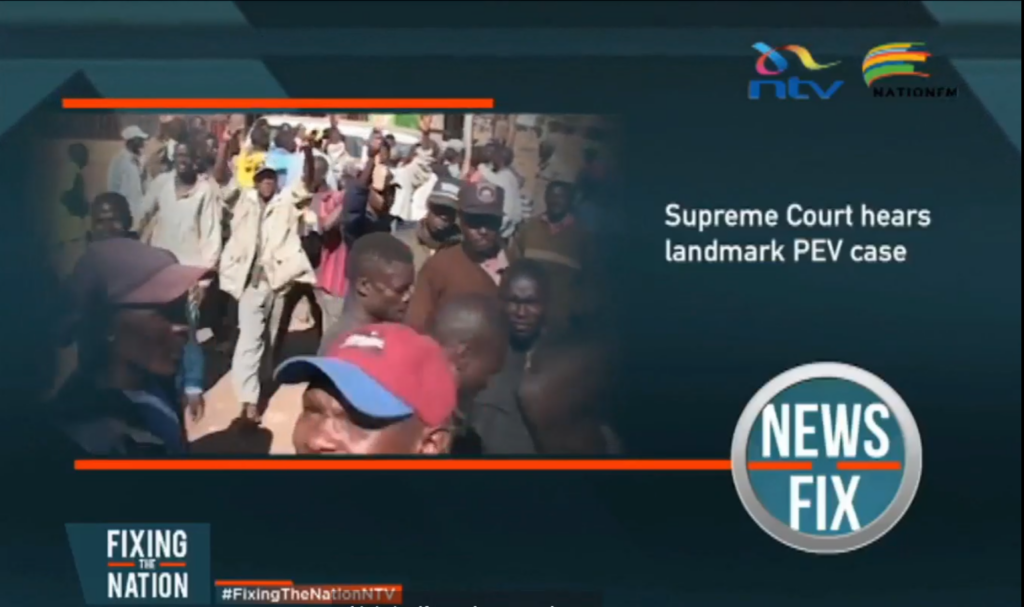
The hearing of Supreme Court Petition No. E041 of 2025 generated media coverage, reflecting the important role journalists play in keeping long-running public interest litigation in the national conversation. For survivors of conflict-related sexual and gender-based violence, sustained reporting helps ensure that years of waiting for justice do not pass unnoticed. It keeps public attention on the pursuit of accountability, highlights the constitutional issues before the courts, and reminds decision makers that survivors continue to seek recognition, reparations, and an effective remedy. Explore how newspapers, television, and digital media reported on the Supreme Court hearing, bringing national attention to survivors’ voices and the constitutional issues before the Court. https://www.the-star.co.ke/news/2026-07-29-state-liable-for-2007-08-pev-police-abuses-court-told https://radiogeneration.co.ke/news/103780/election-violence-survivors-petition-supreme-court-over-delayed-justice https://eastleighvoice.co.ke/news/384554/2007-08-post-election-violence-survivors-return-to-supreme-court-in-fresh-fight-for-justice https://x.com/StandardKenya/status/2082391937630282202/photo/1 https://nation.africa/kenya/news/pev-rape-survivors-seek-equal-compensation-at-supreme-court-5540654 https://www.the-star.co.ke/news/2026-07-29-13-years-on-post-election-sexual-violence-survivors-seek-justice https://newsflash.co.ke/survivors-urge-judiciary-to-fast-track-sgbv-constitutional-cases https://www.kenyans.co.ke/news/125714-supreme-court-hear-case-2007-post-election-sexual-violence-after-13-years  

News, NEWSROOM

Statement: Survivors of Election-Related Sexual Violence Demand End to 13-Year Exclusion at Supreme Court

NAIROBI, KENYA – 29th July 2026 — For nearly thirteen years, survivors of post-election sexual and gender-based violence (SGBV) have waited for the justice promised by Kenya’s Constitution but persistently delayed. During this prolonged delay, children born as a result of the 2007–2008 post-election sexual violence have grown into adulthood and turned 18, while their mothers have continued pursuing justice through Kenya’s court system. Their return to Kenya’s highest court in Supreme Court Petition No. E041 of 2025 (formerly Constitutional Petition No. 122 of 2013 before the High Court and Civil Appeal No. E645 of 2021 before the Court of Appeal) represents a critical effort to end a pattern that has shaped Kenya’s response to political violence for nearly two decades. Whenever Kenya has recognized, compensated, and restored victims of political violence, survivors of sexual and gender-based violence have repeatedly been left behind. Before the Supreme Court, they highlighted the disparity in the State continuing to recognize some victims of political violence while excluding survivors of sexual and gender-based violence from justice, reparations, and constitutional protection. The appeal, brought by eight individual survivors alongside the Coalition on Violence Against Women (COVAW), the Independent Medico-Legal Unit (IMLU), the Kenyan Section of the International Commission of Jurists (ICJ Kenya), Physicians for Human Rights (PHR), and other interested partners, including Utu Wetu Trust and the Kenya Human Rights Commission (KHRC), challenges the State’s failure to prevent, protect against, investigate, prosecute, and provide effective remedies for widespread sexual violence committed during the 2007–2008 post-election violence. A Pattern of Selective Justice & Differential Treatment More fundamentally, this appeal asks the Supreme Court to determine whether survivors of conflict-related sexual and gender-based violence are entitled to the same constitutional protection, recognition, and reparations already extended to other victims of political violence. Although Kenya has compensated victims through different reparative processes, including those established after the 2007–2008 violence and the 2024–2025 protests, survivors of sexual and gender-based violence have consistently remained outside those frameworks despite suffering some of the gravest violations. The petitioners argue this is unfair and unconstitutional; it denies these survivors the equality, dignity, and access to justice that the Constitution promises every Kenyan. Crucially, while the Court of Appeal previously affirmed State responsibility and upheld the High Court’s award of compensation to four survivor-petitioners (the 5th, 6th, 8th, and 9th Appellants) who suffered sexual violence perpetrated by State security officers or who had reported the incidents, it drew an arbitrary and discriminatory line against four other survivors (SMM, SKO, DOJ, and FOO). The Court of Appeal subjected these four survivors to differential treatment, denying them compensation solely because they were attacked by civilian militias/non-State actors or failed to formally report the incidents to police at the time. The petitioners submit that creating a hierarchy of victimhood based on who the perpetrator was or whether a traumatized victim could navigate a reporting system during a national crisis is fundamentally unconstitutional. Key Constitutional & Legal Issues Before the Apex Court At the center of this landmark appeal are fundamental constitutional and international law questions: Rejection of a “Hierarchy of Victims” & Differential Treatment: The appeal challenges the arbitrary distinction made between survivors attacked by State agents and those targeted by private/civilian actors. The Court of Appeal erred by affirming liability and damages for state-actor violations while denying remedies to victims of civilian attacks under the pretext of non-reporting or a strict tort negligence test. Every survivor is entitled to equal protection and effective remedies. Human Rights Due Diligence vs. Civil Tort Standard: The petitioners submit that the Court of Appeal erred by applying a narrow civil tort negligence test (requiring proof of individual police duty of care, breach, and causation) rather than international Human Rights Due Diligence Shifting the Burden of Proof: Having established that the State had prior intelligence and constructive notice of impending and widespread SGBV, the burden of proof must shift to the State to demonstrate the proactive steps it took to protect citizens. Failure-to-Report Barrier: Survivors cannot be denied constitutional remedies simply because they could not formally report crimes to police at the height of widespread violence, trauma, insecurity, and police complicity. Oversight and Accountability of IPOA: Crucially, the petitioners challenge the Court of Appeal’s failure to hold the Independent Policing Oversight Authority (IPOA) accountable. They submit that IPOA possesses a continuing statutory mandate to investigate ongoing, unaddressed historical police misconduct from 2007–2008, and its failure to act leaves scores of survivors without accountability. In Counsel Willis Otieno’s words: “The lack of effective remedies still continues to date. No investigations have ever commenced 13 years later. Constitutional accountability cannot be conditional on expecting traumatized survivors to perform impossible tasks while state security organs stood by.”  The remedies sought are survivor-specific and include compensation, rehabilitation, public acknowledgment, apology, and structural accountability measures. Broader Impact on Access to Justice & Policy Reforms Beyond the courtroom, this appeal speaks to broader questions about access to justice in Kenya. It comes at a time when lawyers across the country have withdrawn from court proceedings to protest delays, growing case backlogs, and barriers to justice. Few cases illustrate that crisis more clearly than this petition. More than thirteen years after survivors first sought constitutional protection, the matter is only now before the Supreme Court. Every year of delay has meant another year without accountability, reparations, or closure for survivors, demonstrating the human cost of delayed justice. The issues before the Court also have implications beyond this appeal. Kenya is currently developing a national compensation framework through the Presidential Working Group on the Establishment of a Framework for the Management of Claims and Compensation chaired by Professor Makau Mutua. That process offers an opportunity to correct decades of exclusion by ensuring survivors of conflict-related sexual and gender-based violence are fully recognized within future reparations programs. A compensation framework that continues to overlook these survivors would only perpetuate the discrimination this appeal seeks to end.   One survivor reflected on the long journey to justice: “I have carried

News, NEWSROOM

Ensuring Full Accountability and Upholding Victims’ Rights in Baby Pendo Case

We, together with fellow victims’ counsel, including representatives of the Law Society of Kenya, Amnesty International Kenya, International Justice Mission, the Kenya National Commission on Human Rights, and the Independent Medico Legal Unit, have moved to the High Court in Kisumu on behalf of victims in the Baby Pendo case through Constitutional Petition No. E011 of 2026, accompanied by an application under certificate of urgency and a supporting affidavit. The petition challenges the decision by the director of public prosecutions to decline prosecution of senior police officers who bore command responsibility for the 2017 post-election violence. Our position remains clear. Accountability for violations of this nature cannot be fragmented, reduced, or reassigned. Decisions that result in the exclusion of senior officers while proceeding only against a limited number of junior officers raise serious concerns regarding the application of the principle of command responsibility and the constitutional guarantee of equal protection and accountability before the law. Justice must reflect the full chain of command, including those who planned, authorized, or oversaw operations, and not be confined solely to those at the lowest levels of implementation. Equally, the rights of victims remain central to this process. Victims have a constitutional and statutory right to participate in proceedings that affect them, including the right to be informed, to be heard, and to have their interests meaningfully considered in decisions relating to prosecution. Any decision that alters the scope of charges or excludes categories of responsibility must take into account the impact on victims and their legitimate expectation that the justice process will be comprehensive, inclusive, and responsive to the full extent of harm suffered. We want to take a moment to sincerely thank all the journalists and media outlets that continue to walk this journey of justice with us. Your consistent reporting and interest in the case kept the public informed and also ensured that the struggle for justice for victims of police brutality is not forgotten. Below are some of the stories covered by the media during the hearing. Daily Nation https://nation.africa/kenya/news/baby-pendo-murder-case-brutality-victims-protest-release-of-8-police-commanders-5422132#story The Standard https://www.standardmedia.co.ke/crime-and-justice/article/2001545258/dpp-sued-over-dropped-suspects-in-baby-pendo-case Citizen Digital https://citizen.digital/article/baby-pendos-parents-want-8-senior-police-officers-charged-in-murder-case-n380649 The Star Newspaper  https://www.the-star.co.ke/news/2026-04-13-victims-challenge-dpp-over-dropped-charges-in-baby-pendo-case The EastLeigh Voice  https://eastleighvoice.co.ke/news/331367/high-court-case-seeks-reinstatement-of-charges-against-senior-police-officers-in-baby-pendo-killing NTV https://web.facebook.com/watch/?v=1639497247297477 Citizen TV https://web.facebook.com/watch/?v=968523352598420 Utu Wetu Trust stands in solidarity with the victims in affirming that accountability must be complete and that justice must uphold both the rule of law and the rights of those most affected.

News, NEWSROOM

John Chebochok: Petition 006 of 2024

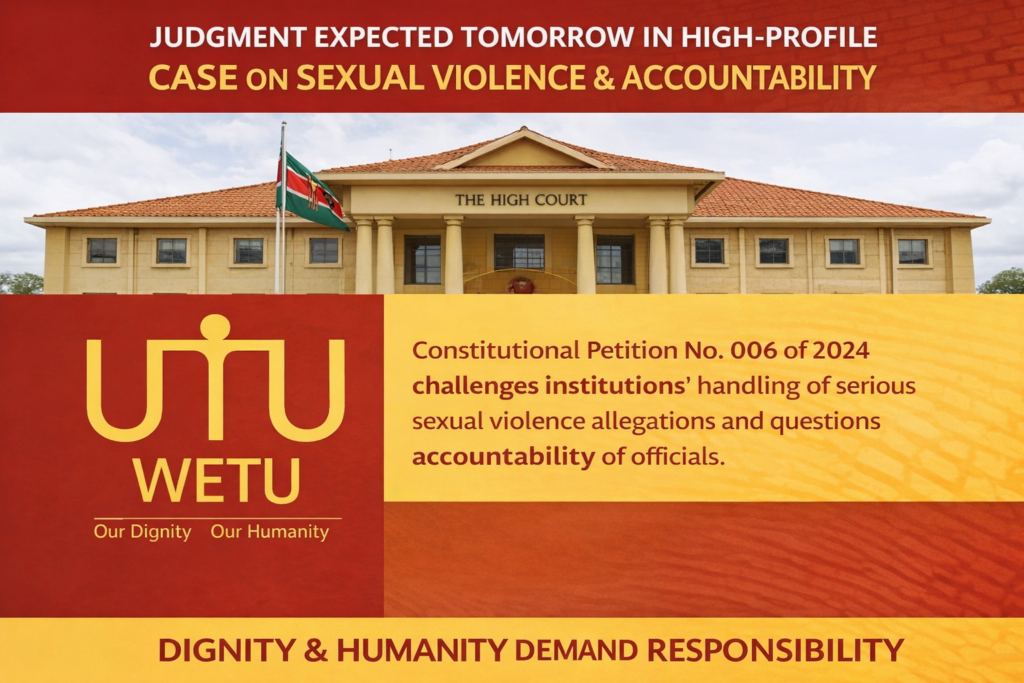
The High Court in Kericho will tomorrow deliver a judgment in Constitutional Petition No. 006 of 2024, a case filed against John Chebochok, the Independent Electoral and Boundaries Commission, KTDA Holdings, the Tea Board of Kenya, and Tegat Tea Factory, which has drawn national attention due to its intersection of sexual violence, power, and public accountability. This petition challenges decisions and actions that failed to respond adequately to serious allegations, and it places before the court a fundamental question about whether individuals facing grave claims connected to sexual violence should continue to hold public office or positions of influence while institutions remain silent or slow to act. For survivors, this is a test of whether the systems meant to protect dignity and enforce responsibility can function when the person accused is powerful and connected, and whether public bodies understand that neutrality in the face of harm often amounts to protection of the status quo. The ruling will signal how seriously our constitutional values are taken when confronted with allegations of abuse and whether public institutions are prepared to prioritize accountability over convenience, influence, or political calculation. For Utu Wetu, this case is about affirming that sexual violence must trigger action, that public trust cannot be separated from ethical conduct, and that survivors deserve more than sympathy because they deserve justice delivered without delay and without compromise.

News, NEWSROOM

ICYMI: An Intrusion in Court Exposed How Violence Follows Survivors Into Online Spaces

Early this year, a virtual session at the Court of Appeal was halted after an intrusion forced the judges to stop the hearing. The session was part of an appeal filed by survivors of the 2007 post-election sexual violence. They have been asking the state to answer for what happened during the conflict period. They were finally in a space where their case could move forward, but the intrusion broke the flow of the day and forced the court to restrict access. Justice Daniel Musinga noted that the intrusion disrupted a process already heavy for the survivors. He said the act disrupted a session meant to address harm that had occurred years earlier. Only lawyers were allowed back into the virtual room once the system was secured. For the survivors, the appeal was part of a long path where they had to explain what happened to them and why the state should carry responsibility. They asked the court to look at the failures to prevent the violence and to look at the gaps in protection and response. But the intrusion during the hearing exposed a new layer of pressure as survivors who faced harm during the conflict faced a second form of harm inside the same process that is meant to bring justice. Their first fight took place in the streets, homes, and shelters where the violence was physical and visible. The fight moved into digital spaces as the court session was disrupted through a screen and the entire process was pushed off balance by someone who stepped in through a virtual door and tried to break a hearing that survivors had waited years to reach, showing that the tools of harm have shifted from the streets and homes where the first violence took place to online spaces where silence is enforced through interference rather than force. The same survivors who struggled to be heard in the physical world stretched themselves once more to hold ground in a space they did not choose and could not control, carrying a double burden that grows heavier each time the system fails to protect even the small steps they have taken toward recognition and justice. At Utu Wetu, we see how harm travels from one space to another and how survivors are forced to fight in two arenas at once while institutions move slowly and offer little protection in either space, leaving them to carry the strain of both the original violence and the new disruptions that meet them when they seek answers.  We cannot allow digital interference to become another gate that survivors must push through on their own, and we cannot stand back while silence shifts from physical intimidation to technological disruption without naming it and confronting it. Utu Wetu will hold this line because the fight for justice must stand in every space where survivors speak, and because the struggle cannot pause each time the tools of harm change shape.

News, NEWSROOM, STRATEGIC IMPACT LITIGATION

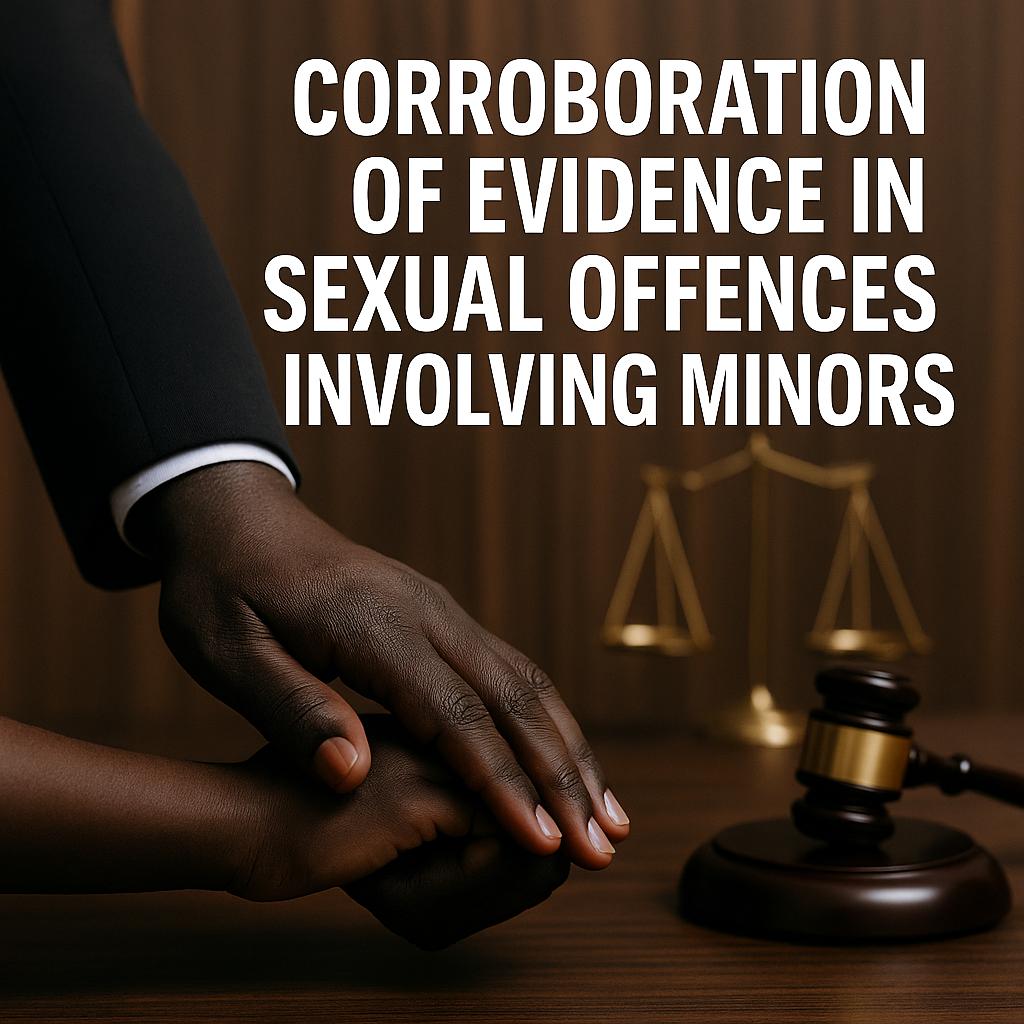
Corroboration of Evidence in Sexual Offences involving Minors: Application of Section 124 of the Evidence Act in Kenya

By Joyce Ochieng Sexual offences against minors are regarded as very serious crimes in Kenya. A child or a minor is any person who has not attained the age of eighteen years.[1] A national survey on Violence Against Children in Kenya conducted in 2010 found that 23% of girls and 12% of boys aged 13–17 had experienced sexual abuse. Among 18–24-year-olds, 32% of women and 18% of men experienced childhood sexual abuse before age 18.[2] The Constitution upholds the paramount principle which safeguards the best interests of the child, protects the child from all manner of abuse and recognizes their vulnerable nature and need for protection by the State.[3] Furthermore, the Sexual Offences Act, 2006 criminalizes any acts of sexual violence against minors, including defilement and indecent acts. Children are also regarded as vulnerable witnesses on account of their age, and appropriate measures should be taken in safeguarding their interests during trial.[4] The penalties ascribed in the Sexual Offences Act range from lengthy prison terms to life imprisonment. In this regard, the Supreme Court, in Republic v Mwangi; Initiative for Strategic Litigation in Africa (ISLA) & 3 others (Amicus Curiae) (Petition E018 of 2023)[5] held that the blanket application of the ratio decidendi in the Muruatetu case by the Court of Appeal in Nyeri conflated the concept of mandatory sentences with minimum sentences, thereby supporting the position that life imprisonment in sexual offences cases is in fact grounded in statute, and lawful. Corroboration refers to additional evidence that provides certainty or supports a statement of fact. Evidence that is corroborated is relevant, admissible, credible, independent and implicates the accused according to the manner that a specific statute requires. Corroboration reduces the chances of convicting an innocent person.[6] Historically, the Kenyan courts viewed sexual offences with suspicion, hence the requirement to seek corroboration of the complainant’s testimony, as a matter of practice, before a conviction could be entered.[7] However, in Mukungu v Republic (2003), the Court of Appeal declared that the practice requirement for corroboration in sexual offences was discriminatory against women and girls and therefore unconstitutional. The court acknowledged the caution in relying solely on the complainant’s testimony as was stated in Maina v Republic [1970] EA 370 but noted that the same caution was not required concerning women and girls’ testimonies in other offences. The court relied on the cases of Republic v Cherop A Kinei and Another [1936] 3 EACA 124 and Chila v Republic [1967] EA 722 at 723 (CA), where uncorroborated evidence was used to convict the accused persons.[8] These exceptions applied where the court, despite duly cautioning itself on the risks of relying on uncorroborated evidence, was satisfied that the complainant is telling the truth.[9] Further, section 124 of the Evidence Act No. 46 of 1963 was amended by section 103 of the Criminal Law (Amendment) Act, 2003, and later by the Sexual Offences Act, 2006, formally incorporating the aforementioned exception in statute, in relation to corroboration of evidence in sexual offences cases. The 2003 amendment was particularly about children and read as follows: “Section 124 of the Evidence Act is amended by inserting the following proviso– Provided that where in a criminal case involving a sexual offence the only evidence is that of a child-of tender years who is the alleged victim of the offence, the court shall receive the evidence of the child and proceed to convict the accused person if, for reasons to be recorded in the proceedings, the court is satisfied that the child is telling the truth.” Section 124 of the Evidence Act, pursuant to the amendment by the Sexual Offences Act, states that: “Notwithstanding the provisions of section 19 of the Oaths and Statutory Declarations Act (Cap. 15), where the evidence of the alleged victim is admitted in accordance with that section on behalf of the prosecution in proceedings against any person for an offence, the accused shall not be liable to be convicted on such evidence unless it is corroborated by other material evidence in support thereof implicating him: Provided that where in a criminal case involving a sexual offence the only evidence is that of the alleged victim of the offence, the court shall receive the evidence of the alleged victim and proceed to convict the accused person if, for reasons to be recorded in the proceedings, the court is satisfied that the alleged victim is telling the truth.” The effect of this amendment is that an accused person can be convicted solely on the testimony of the victim, provided that the court is satisfied that the victim’s testimony is truthful, and records its reasons or justifications for relying on the uncorroborated evidence. Despite the comprehensive legal framework, successful prosecutions are often barred by the evidential hurdle of corroboration. In practice, the courts continue to emphasize that the testimonies of victims should be corroborated. The presence or absence of corroboration often decides the outcome in sexual offences cases. Notwithstanding the clearly stipulated section 124 of the Evidence Act, judicial officers have continuously showed reliance on medical reports, additional witnesses, circumstantial evidence and other corroborative materials in making their determinations, as evidenced below. Case Law Analysis: Michael Waweru case vis a vis Peter Mwaura case In Republic v Michael Waweru Kihiu (MCSO/40/2020), Utu Wetu Trust represented the victim’s family, providing legal support and safeguarding the survivor’s interests throughout the proceedings. The accused was convicted of defilement contrary to section 8(1) as read with section 8(3) of the Sexual Offences Act, 2006, and sentenced to twenty years’ imprisonment by the Ruiru Law Courts. The alternative charge was committing an indecent act with a child contrary to section 11(1) of the Sexual Offences Act, No. 3 of 2006. The judgment, delivered on June 19, 2023, turned on three key issues: whether the victim was a child; whether penetration occurred; and whether the accused was positively identified as the perpetrator. This tri-partite test remains a consistent judicial standard in the determination of defilement cases in Kenya. In determining whether the

NEWSROOM, UTU WETU VOICES

Dr Aoko: A Reflection on My Experience at ISLA Institute

My experience at the Institute for Strategic Litigation in Africa (ISLA) was both intellectually enriching and personally transformative. Although I attended the programme virtually, it offered a deeply engaging and interactive learning environment that broadened my understanding of gender justice and human rights litigation in Africa. One of the most significant lessons I took away from the institute was on obstetric violence, a topic I had not previously explored in depth but which has since reshaped my understanding of women’s rights and reproductive justice. Before the sessions, I was familiar with the broad framework of gender-based violence. However, the discussions and case analyses at the institute illuminated how systemic mistreatment of women in reproductive healthcare settings constitutes a form of gendered violence and a violation of fundamental human rights. I was particularly struck by the intersection of law, ethics, and public health in addressing obstetric violence, and by the realisation that such violations are often normalised against women within healthcare systems. Through the presentations and peer exchanges, I learned how strategic litigation can be used as a tool to challenge these patterns, seek accountability, and drive policy reform. Despite attending online, I felt part of a vibrant group of advocates and scholars committed to transforming the human rights landscape through the recaps and various presentations. The facilitators were not only knowledgeable but also generous with their insights, encouraging critical thinking and collaboration among participants. I appreciated how the sessions combined theoretical rigour with practical application, allowing us to examine real cases and develop arguments grounded in human rights law. Participating in the moot court component of the institute was one of the highlights of my experience. It provided an opportunity to put the knowledge and advocacy skills I had gained into practice. I was deeply honoured to be named runner-up in the Best Oralist category, and even more thrilled to receive the Best Oralist in Human Rights Violations award. These recognitions were affirmations of my growing confidence and commitment to advancing justice through advocacy and strategic litigation. The ISLA experience reaffirmed my belief in the power of law as a vehicle for social transformation. It also reminded me that even within virtual spaces, meaningful learning and community building are possible when guided by shared purpose and passion. I am sincerely grateful to the ISLA team for the opportunity to participate in such an impactful programme. The lessons I have learned will undoubtedly inform my future work in human rights advocacy, particularly in advancing accountability for reproductive and gender-based injustices. I look forward to the next institute with great enthusiasm, ready to deepen my knowledge, engage with new perspectives, and continue contributing to the cause of gender justice across Africa.   Dr Leah Aoko is our programs officer.   

News, NEWSROOM, STRATEGIC IMPACT LITIGATION, Uncategorized

Court Moves Baby Pendo Case to Kisumu

In September, the big story for us was the transfer of the Baby Samantha Pendo case from Nairobi to Kisumu. The High Court of Kenya agreed that since the killing and other abuses happened in Kisumu, and most witnesses and survivors are based there, it is the proper venue for the trial. Human rights organisations, including Utu Wetu Trust, Amnesty International Kenya and International Justice Mission, welcomed the move but emphasised that this is only a preliminary step toward accountability. They pointed out that the case has been delayed by years, repeatedly bounced between judges, and seen charges dropped and key suspects remain at large. What this really means is that venue change alone won’t guarantee justice unless the courts, the prosecution and oversight agencies now commit to a clear timeline, ensure witness protection, and respect victims’ rights to participate. Utu Wetu will continue to monitor every step. Different media outlets covered this development with our support and alongside our partners. Below are links to their coverage. Radio Jambo Classic 105 Nation https://www.facebook.com/share/p/1CbpmDQ8iU/?mibextid=wwXIfr Capital FM https://www.capitalfm.co.ke/news/2025/09/court-moves-baby-pendo-case-to-kisumu-orders-police-commission-to-facilitate-accused-officers/ 2. https://www.capitalfm.co.ke/news/2025/09/rights-league-welcomes-transfer-of-baby-pendo-case-to-kisumu-decries-delays/ Eastleigh Voice https://eastleighvoice.co.ke/news/215711/high-court-orders-transfer-of-baby-pendo-murder-case-to-kisumu https://eastleighvoice.co.ke/national/217093/rights-groups-welcome-moving-of-baby-pendos-case-to-kisumu-push-for-speady-prosecution The Star Newspaper https://www.the-star.co.ke/news/2025-09-26-justice-for-baby-pendo-must-move-from-paper-to-action-say-lobbies  

Scroll to Top